

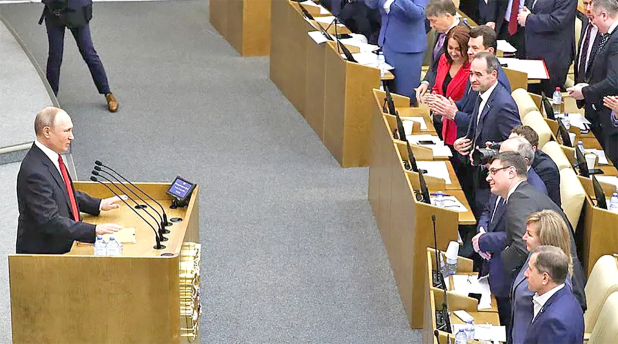
As a Russia watcher in Bahrain, present developments are interesting. China repealed presidential term limits two years ago, thereby in effect allowing President Xi to remain in office indefinitely. The model clearly appealed to President Putin. Though formally required by Russia’s constitution to relinquish office at the end of his second six-year successive term in 2024, Putin is supporting a proposed mechanism that would enable him to stay on.
A member of Putin’s party in parliament has proposed an amendment that would reset to zero the number of presidential terms that he has served. Putin told parliament, with an affectation of propriety, that Russia’s constitutional court would first have to endorse such a change. There is little room for doubt that the court will do as he wishes.
In practice, the blatancy of this ruse, which comes after other paths to extending his term including a proposed union with Belarus were thwarted, may signal a brittleness to the regime in his absence that he would prefer not to test. Regardless of his calculation, Putin’s evident desire to remain as president will complicate and probably stymie any hopes of rapprochement. This 21st-century cold war is likely to persist, with little that America and its allies can do to affect the outcome other than practise the same strategy of patient containment that eventually prevailed against Soviet communism.
By the end of his present term, Putin will be 72. He will have held power continuously for 24 years, though with the political fiction of having held prime ministerial rather than presidential office between 2008 and 2012 to comply with term limits. If he completes two more six-year terms he will become Russia’s second longest- lasting leader after Peter the Great, who ruled for 43 years, ahead of Catherine the Great’s 34 years, and well ahead of Stalin’s 29 years.
Whether because of his advancing years or his distrust of any alternative candidate, Putin has opted not to step aside this time. Instead, his model appears to be the more brazen one of simply sidestepping constitutional niceties, in the manner of Alexander Lukashenko, who has held presidential power in Belarus, often described as Europe’s last dictatorship, for almost 26 years.
When Putin’s domination of domestic politics has been challenged in the past, he has responded with brutal repression within Russia’s borders and beyond. The illegal annexation of Crimea in 2014 gave a boost to his flagging popularity. His backing for the campaign of bloodshed by President Assad against Syria’s people has likewise been designed to project an image of strength. Western foreign policy has long sought to prevent an autocratic alliance between Russia and China. Putin’s power grab makes this a more complex task.
T L
&uuid=(email))