People in Bahrain are being urged to take steps to protect themselves from a potential ‘heat dome’ that could form sometime next week, resulting in dangerous temperatures.
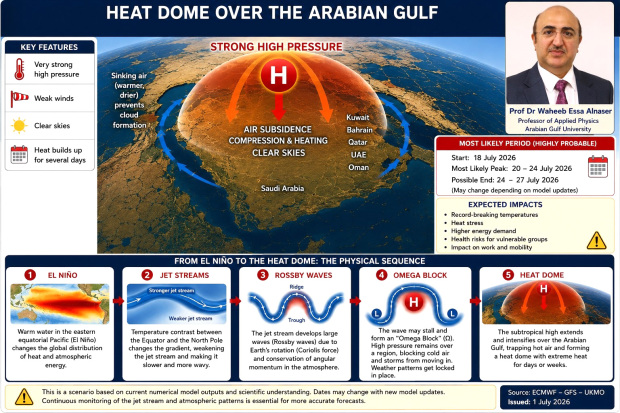
Arabian Gulf University professor of applied physics Dr Waheeb Alnaser said that the phenomenon could occur during the second half of this month if subtropical atmospheric pressure continues to strengthen over the Arabian Peninsula over the next few days.
He stated that as descending air is compressed, it warms adiabatically (without any heat being added), suppressing cloud formation, weakening winds, and allowing heat to accumulate over several days, potentially reaching up to 50C.
“This phenomenon is commonly known as a heat dome,” said Dr Alnaser.
“It rarely develops in isolation and may represent the final stage of a sequence of interconnected atmospheric processes that begins with changes in the ocean-atmosphere energy balance, such as El Niño.
“These changes can alter behaviour, increasing the amplitude of Rossby waves (massive, meandering undulations in the Earth’s jet streams and ocean currents), which under favourable conditions may evolve into an Omega Block (stationary weather patterns).
“This allows high-pressure systems to remain stationary for extended periods, creating ideal conditions for prolonged heatwaves.
“If this blocking pattern extends towards the Arabian Peninsula, it may favour the development of a large regional heat dome.”
In a heat dome, a large, stagnant area of high-pressure atmospheric air forces warm air downward. As the air sinks, it compresses and warms significantly in what is known as the ‘Lid Effect’.
The high pressure effectively blocks any incoming weather fronts, clouds, or cooling storms.
With clear, cloudless skies, the sun beats down directly on the ground, rapidly drying out moisture and causing the surface to absorb and radiate even more heat into the air.
Heat domes are incredibly dangerous for both the environment and human health.
Because they prevent cool nighttime air from moving in, overnight temperatures remain elevated, giving the human body, crops and animals no time to recover from the intense daytime highs.
These sustained periods of extreme heat frequently lead to dangerous heatwaves, drought and increased wildfire risks.
“Current numerical weather models suggest an increased probability of a heat dome occurring approximately between July 18 and 27, with peak heat occurring between July 20 and 24,” said Dr Alnaser.
“Should this scenario materialise, exceptionally high temperatures, increased heat stress, and greater electricity demand are expected across much of the GCC.
“Warm Gulf waters may further enhance humidity, reducing the human body’s ability to cool itself efficiently.
“Monitoring the evolution of the jet stream and Rossby waves over the coming days will be essential for determining whether this projected heat dome will fully develop or weaken before reaching maturity.”
To stay safe during a heat dome, people must prioritise internal cooling, secure an air-conditioned environment, and strictly avoid physical exertion during peak sun hours.
Stay in air-conditioned environments as much as possible and close all blinds, curtains and external shutters on windows exposed to direct sunlight during daylight hours.
Avoid using ovens, stoves, or incandescent lighting, which generate significant ambient indoor heat.
Stay indoors during peak sunlight hours and wear lightweight, loose-fitting, light-coloured clothing made of breathable fabrics like cotton.
Drink water regularly, incorporate drinks containing electrolytes to replace minerals lost through heavy sweating, and skip sugary drinks and caffeine.
Meanwhile, research released earlier this year titled ‘Building A Heat Resilience Roadmap for the Gulf Region’ stated that the escalating heat challenge facing the GCC countries will only worsen in the coming years.
The research done by Dubai-based ORF Middle East’s Leigh Mante, stated that rapid urbanisation and diversification towards non-oil activities will cause urban heat to intensify, increasing demand for cooling, and straining electricity grids and increasing carbon emissions.
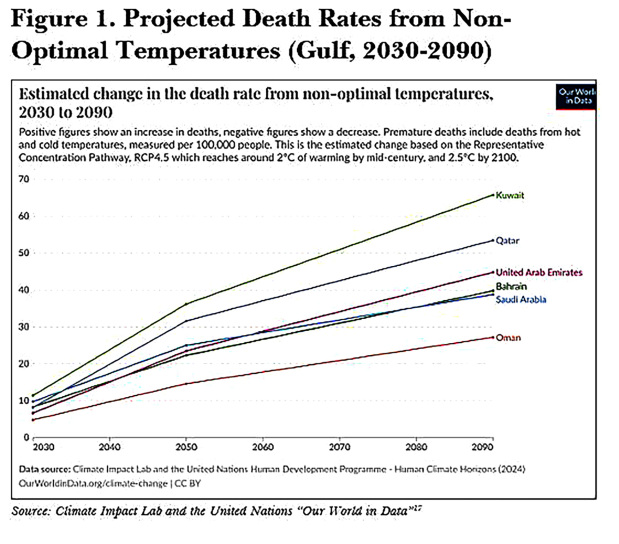
“Projections indicate that maximum temperatures in GCC cities during the summer are likely to increase by approximately 0.6C per decade through the end of the century, potentially exceeding 55C under a business-as-usual scenario,” the report said.
“In GCC cities, humidity from coastal areas combined with heat absorption from urban materials and fewer green landscapes contribute to raising temperatures to uncomfortably high levels.
“Prolonged heat waves strain urban systems, leading to health crises, compromised infrastructure, and supply chain vulnerabilities.”
According to the research, extreme heat undermines labour productivity and the GCC’s economic output.
By 2030, the UAE is predicted to experience the largest heat stress-induced job losses and a 2.6 per cent reduction in total working hours.
Qatar is expected to be the most negatively impacted, losing 5.3pc of its total working hours from heat stress, followed by Bahrain at 4.1pc.
In an attempt to combat these rising temperatures, the UAE leads in the integration of its National Green Building Codes and mandatory rating systems that holistically evaluate buildings on energy efficiency, water conservation, materials selection and site sustainability.
Bahrain and Qatar also have comprehensive energy efficiency mandates – Bahrain’s National Energy Efficiency Action Plan (NEEAP) and Qatar’s Global Sustainability Assessment System (GSAS).
Launched in 2017, NEEAP is a strategy designed to minimise overall energy consumption and support Bahrain’s environmental goals. It set a target to reduce final energy consumption by 6pc by 2025.
It included projects such as the implementation of a Green Building Code for all new constructions, promotion of district cooling systems, upgraded insulation, and the complete transition of government street lighting and indoor ministry lighting to energy-efficient LEDs.
As of 2026, Bahrain has fully met its primary NEEAP energy efficiency target ahead of schedule and has formally integrated it into the National Energy Strategy, which aims for a 30pc carbon reduction by 2035 and net-zero emissions by 2060.
Over the next few days, wind speeds in Bahrain are expected to decrease gradually and humidity levels are likely to rise in the coming days, especially during nighttime hours.
Temperatures are expected to remain consistent until Saturday, peaking at 44C in the afternoons before decreasing to 30C at night. Wind speeds will gradually decrease from 18 knots today to just 10 knots by Saturday.
nader@gdnmedia.bh