

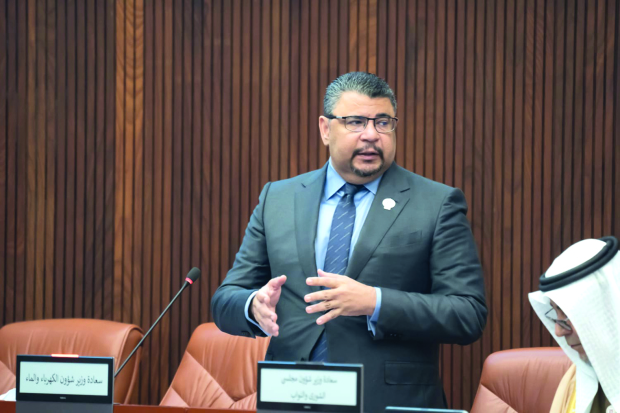
Plans are underway to draft a new law that would lead to the reorganisation of the electricity and water sector and bolster its transparency and operational efficiency, it has been revealed.
Electricity and Water Affairs Minister Yasser Humaidan said the aim was to separate the operational and regulatory duties at the Electricity and Water Authority (EWA) to enhance governance, safeguard consumer interests and ensure the quality and reliability of services.
“Reorganising the sector would positively impact its financial status,” said Mr Humaidan.
“The proposed reforms will enhance the oversight of operational expenditures and enable better assessment of the feasibility of capital investments,” he added.
“This will ensure maximum efficiency and quality in service delivery.”
The minister was responding in writing to a parliamentary question by MP Mohammed Al Ahmed on plans for the sector.
Mr Humaidan, who is politically responsible for the EWA, emphasised ongoing efforts to enhance the organisation and governance of the electricity and water sector.
He also highlighted technological developments, pointing out that smart meters offered precise measurements of consumption and complied with international performance standards.
“Smart meters feature remote reading capabilities, eliminating the need for manual meter readings. This reduces operational costs associated with field visits and minimises estimated readings,” Mr Humaidan said.
“These meters provide accurate data that improve grid management.
“They also allow consumers to monitor and manage their consumption more effectively.”
The minister further explained that the meters offered automatic disconnection of power in cases of excessive loads, protecting consumers and their devices.
“Another key advantage is the swift activation of consumer accounts,” the minister explained.
“Electricity can be connected or disconnected in a matter of minutes through the eGovernment portal, without the need for physical visits or manual intervention, as was previously required.”
He added that this automation enhances service efficiency and consumer convenience.
Mr Humaidan also assured that the EWA employs precise procedures to collect outstanding amounts.
“Monthly bills clearly state the amounts due, and consumers who fail to pay on time receive notifications via their bills, text messages, and emails,” he said.
“If payment delays persist, the authority takes action to disconnect the power supply.
“To ease the burden on consumers, the EWA provides various payment plans, including fixed-rate agreements that help consumers budget their payments throughout the year.
“Additionally, for those with financial constraints, the authority offers instalment plans to manage overdue payments.”
He said through these measures, the EWA reaffirms its commitment to enhancing transparency, governance, and consumer satisfaction while aligning with international standards.
“The authority continues to modernise its operations, ensuring the efficient delivery of reliable and high-quality services to the public.”
mohammed@gdnmedia.bh
Top stories for today:
Bahrain's exports to UAE top $1 billion
Applications invited for youth peace programme
Interior Ministry takes part in Retro Manama
&uuid=(email))