

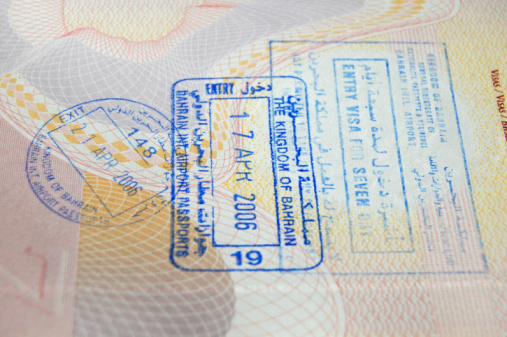
Obvious misspellings and blatant factual errors in the passport of a wanted man may have helped authorities detect the alleged forgery of stamps in the vital document.
Four Bahraini men, including two clerics, an imam and a driver, have been accused of being involved in a scam to illegally renew the passports of fugitive Bahrainis residing abroad, or ones wishing to leave the country.
The forged stamps had clear spelling mistakes in the parts written in English, and were signed by the ‘Diroctor of Passports’ and not the ‘director’.
The stamps also read ‘Republic of Bahrain’ instead of ‘Kingdom of Bahrain’, a mistake on the part of the alleged forger.
‘The valldity of this passport is renowed unti…’ and ‘Not to be usdd aftar thot bere unless renewt’ were some of the error-ridden sentences in the stamps that aroused the suspicion of officials.
A fifth defendant, the 29-year-old owner of a passport that was allegedly illegally renewed, is reportedly wanted by authorities on suspicion of another crime.
He was the only one to appear at the High Criminal Court trial as all his co-defendants, aged between 36 and 67, are out of the country.
The men have been charged with replicating signatures and stamps attributed to the Nationality, Passports and Residence Affairs (NPRA), in order to extend the validity of the fifth defendant’s passport.
The Bahrainis have also been accused of committing a forgery with the intention of using it to achieve a specific goal.
The fifth man was charged with aiding and abetting his co-conspirators and providing them with his passport in which they placed the replicated stamps.
He was further accused of using the forged passport while being aware of the fact it was not genuine, when he crossed the border into Saudi Arabia.
He admitted to all charges.
Court documents state that the man had allegedly planned to use the renewed document to travel to Kuwait, and ultimately reach his destination of Iraq, which prosecutors claimed was an ‘escape attempt’.
One of the defendants is a senior cleric who resides in an Arab country while two others have already been sentenced to life – in absentia – on various charges related to national security. “The stamps were attributed to the NPRA and were purported to be signed by the Director of Passports,” read the report issued by a forensic forgery specialist, submitted to the court.
“We compared the genuine and fake stamps and found major and fundamental differences between the two.
“Some of the dates on the fake stamps have been written twice, and they were signed with a ballpoint pen.”
Investigators allege that the four men have previously executed similar schemes to fraudulently obtain new personal documents from the NPRA, though it was not specified whether they were ever found guilty in relation to this so-called racket.
The court has set January 14 as the date for a verdict in the case.
zainab@gdnmedia.bh
&uuid=(email))