

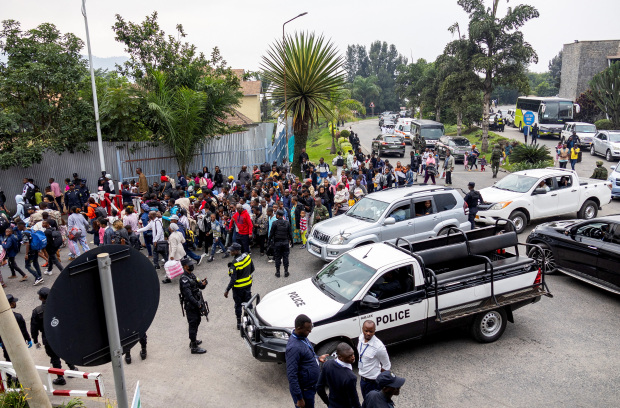
GOMA, Democratic Republic of Congo - R wandan-backed rebels marched into east Congo's largest city Goma on Monday and Congolese troops exchanged fire with the Rwandan military across the border, in the worst escalation of a long-running conflict for more than a decade.
A rebel alliance led by the ethnic Tutsi-led M23 militia said it had seized the lakeside city of over 2 million people, a major hub for displaced people and aid groups lying on the border with Rwanda and last occupied by M23 in 2012.
The deep pounding of heavy artillery fire and rapid rat-a-tat of gunshots could be heard in a video of Goma airport, posted on social media and verified by Reuters, that showed unidentified armed men running on airport grounds.
"We can still hear gunfire coming from the airport. A rocket landed close to the church, behind our house," said one resident, speaking from Goma's northeast Majengo neighbourhood.
Residents reported hearing or seeing clashes between government-aligned militia and M23 fighters in other areas too.
Corneille Nangaa, leader of the Congo River Alliance that includes the M23, told Reuters his forces were in control of Goma. "They (army soldiers) have started to surrender, but it takes time," he said. This could not be independently verified and it was unclear if the whole city was under M23 control.
Congo accused Rwanda of sending troops into its territory and threatening "carnage". The government urged residents to stay at home and refrain from looting.
Rwanda said fighting near the border threatened its security, requiring "a sustained defensive posture". Rwanda's army later said Congolese shelling had killed five people and injured 26 in the town of Rubavu, near the border, and Rwanda would respond in order to protect its civilians.
Congolese soldiers positioned on Mount Goma, a hill within the city, exchanged artillery fire with Rwandan troops on the other side of the border, in the town of Gisenyi, according to two U.N. sources speaking from a U.N. site between the two.
A Reuters reporter in Gisenyi saw columns of people fleeing, some holding children by hand or carrying heavy bags. One man had a mattress on his head. Gunfire could be heard in the background.
LOOTING AND JAILBREAK
Unverified videos posted on social media showed local residents looting merchandise outside the airport customs warehouse. Adding to the chaos, thousands of inmates broke free from Goma's main prison, a prison official said.
Hundreds of thousands of people displaced by recent fighting or earlier conflict have sought refuge in Goma and in surrounding camps. The arrival of M23 rebels in the city risks causing a new displacement and humanitarian crisis.
In the Congolese town of Bukavu, about 200 km south of Goma on the opposite end of Lake Kivu, thousands of people demonstrated against what they described as Rwandan aggression.
Roughly the size of Western Europe, the Democratic Republic of Congo is home to 100 million people and its plentiful mineral supplies have long been coveted by Chinese and Western companies as well as by armed groups.
Its eastern borderlands are a tinderbox of rebel and militia fiefdoms stemming from two regional wars after Rwanda's 1994 genocide, when Hutu extremists murdered close to 1 million Tutsis and moderate Hutus. Many Hutus, some of them genocide perpetrators and others refugees, fled into Congo after the genocide, which is one of the root causes of instability there.
The U.N. has warned that the M23 offensive risks spiralling into a broader regional war.
Kenys said that Congo's President Felix Tshisekedi and his Rwandan counterpart Paul Kagame had agreed to attend an online meeting on Wednesday.
Rwanda has in recent years received abundant aid and diplomatic support from Western governments despite rights groups criticising its record at home and in Congo. On Monday, it reacted with fury to the criticism from Western powers, presenting itself as victim rather than aggressor.
"The righteous international community is back, issuing statements asking for the targets of ethnic violence to exercise restraint," said government press secretary Stephanie Nyombarire in a post on X, accusing Rwanda's critics of forgetting the lessons of the genocide.
COLTAN MINE TAKEN
Congo accuses Rwanda of using M23 to control swathes of Congolese territory for the purpose of looting minerals, which Kigali denies.
U.N. experts said M23 had conquered Rubaya, the largest coltan mine in the Great Lakes region, and exported at least 150 tonnes of coltan, which is used in smartphones, via Rwanda.
M23 last captured Goma in 2012 but withdrew days later after an agreement brokered by neighbouring nations.
That led to the deployment of a new offensive-minded U.N. force, an overhaul of the Congolese army and diplomatic pressure on Rwanda, leading to the M23's defeat the following year and a deal calling for its demobilisation.
But the group never fully disarmed and launched a fresh offensive in 2022 that has seen it capture large parts of mineral-rich North Kivu province.
In an interview before the offensive on Goma, Nangaa, the alliance's leader, suggested it aspired to replace Tshisekedi and his government.
"Our objective is neither Goma nor Bukavu but Kinshasa, the source of all the problems," he said, referring to the Congolese capital, more than 1,500 km west of Goma.
"In Congo, we have a weak state or a non-state. Where all the armed groups have sprung up, it's because there's no state. We want to recreate the state."
&uuid=(email))