

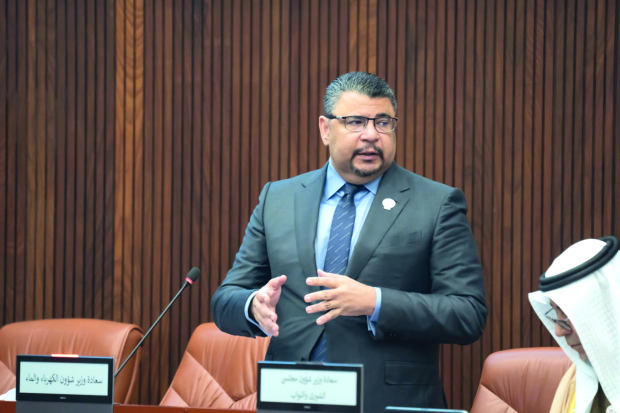
The Electricity and Water Authority (EWA) has achieved a significant milestone in cost reduction, saving BD68 million in 2023 alone, following BD31m in savings in 2022, it has been revealed.
Electricity and Water Affairs Minister Yasser Humaidan, who is also politically responsible for the EWA, said in writing that the authority expects to match this achievement in 2024, with an estimated BD68m in projected cost savings.
This is the result of a long-term strategic transformation emphasising efficiency, technology and responsible financial management, he said.
“Efficiency and innovation are the backbone of our sustainability efforts,” he added.
“We are committed to providing reliable services while ensuring the financial viability of our sector.”
According to the minister, the cost to purchase a unit of electricity stands at 21.7 fils per kilowatt-hour, while the indirect operating cost for transmission and distribution adds 7.5 fils per kilowatt-hour. This brings the overall average cost to nearly 29 fils per unit, while Bahraini citizens pay significantly less due to subsidies.
Mr Humaidan explained that the shift from internal production to electricity purchase from independent power producers (IPPs) has been a critical move in reducing overall costs. “This transition, which began more than two decades ago, has enabled the use of more modern and fuel-efficient technologies, reducing long-term capital and operational expenditure,” he pointed out.
“Electricity generation is a complex and evolving process,” he noted, citing fluctuating fuel prices, equipment efficiency and maintenance demands.
“Independent production is generally more cost-effective and technologically advanced, ensuring a more reliable energy supply while reducing the burden on public resources.”
Mr Humaidan said the EWA has undertaken numerous studies and investment projects aimed at cost reduction across the production, transmission, and distribution chain.
“These include smart metering and digital infrastructure to enhance billing accuracy and reduce administrative overhead,” he explained.
“Other measures are, reduction in electricity losses through infrastructure upgrades and system optimisation; closure of inefficient plants such as Sitra and Riffa in favour of high-efficiency facilities like Dur Two; and switching water desalination methods from thermal evaporation to reverse osmosis, which is significantly more energy-efficient.”
Mr Humaidan added that financial performance was also being optimised through improved gas consumption, economic load dispatch, outsourcing services, and value-added services like ESCOs (Energy Service Companies), which provide energy efficiency solutions.
“These efforts have helped stabilise electricity prices despite global inflation and rising costs of raw materials,” the minister said.
He confirmed that government support for electricity accounts reached BD161m in 2023, according to audited financial statements.
“While monthly breakdowns were unavailable due to the seasonal and variable nature of consumption, detailed figures were provided by tariff band,” he pointed out.
Bahraini residential accounts:
- 0-3,000 kWh at 3 fils: BD105m
- 3,000-5,000 kWh at 9 fils: BD20m
- Above 5,000 kWh at 16 fils: BD15m
- Non-household accounts (16 fils): BD21m
Mr Humaidan said that with continuous investment in infrastructure, adoption of global best practices, and a commitment to digital transformation, the ministry was charting a path towards a more sustainable and cost-effective future.
“Every dinar saved goes back into improving the services we provide to citizens,” he said.
The minister was responding to a question by Parliament’s legislative and legal affairs committee chairman MP Mahmood Fardan on electricity costs.
Meanwhile, Mr Humaidan also highlighted EWA’s collaborative efforts with the Social Development Ministry to help citizens.
“Eligible low-income citizens benefit from government assistance through monthly electricity and water bill deductions ranging between BD10 and BD20,” he said.
“The EWA does not classify subscribers by income, but it relies on lists from the Social Development Ministry. These targeted subsidies reflect our commitment to social responsibility.”
He added that in cases where account holders die, the EWA does not transfer debt to heirs beyond the value of the inherited estate. However, for services to continue, the account must be registered in the name of a living heir.
“We always take into account the financial and social situation of widows and children,” Mr Humaidan added.
He stressed that the tariff for Bahraini citizens with one account was significantly subsidised, covering just 21.7pc of the actual electricity cost and 6.2pc of water cost.
“The current tariffs are among the lowest when compared globally, thanks to government subsidies and cost-efficient production methods,” he noted.
The minister called on citizens and residents to rationalise electricity and water consumption as it not only reduces government expenditure, but also supports the long-term sustainability of resources.
He confirmed that while there are no immediate plans to reduce subsidies, the long-term strategy includes maintaining service quality while managing economic pressures.
The minister will be available during the weekly session on Tuesday to respond to further queries by MPs.
Also, set for debate is an urgent government-drafted legislation for financing from the Islamic Development Bank to fund the new 400 Kilo Volt Electricity Plant in Jasra.
The loan, which will be granted to the EWA can’t exceed $200m, over a period of seven years.
Mr Humaidan said the plan is to improve electricity services through this facility by 2027.
mohammed@gdnmedia.bh
&uuid=(email))