

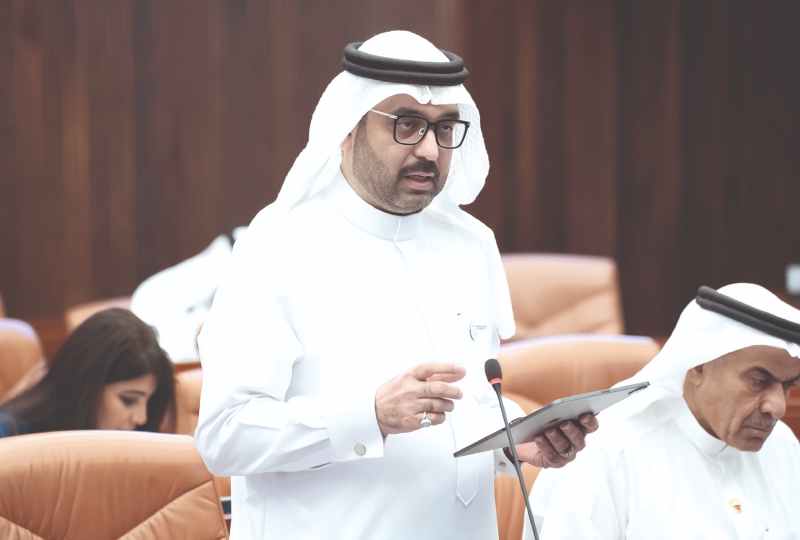
A parliamentary panel has submitted 11 key recommendations in response to the 2023-2024 report by the National Audit Office (NAO), aiming to enhance government accountability and financial transparency.
Parliament’s financial and economic affairs committee, chaired by MP Ahmed Al Salloom, stressed the importance of its recommendations, which have been presented to MPs to vote on during Tuesday’s weekly Parliament session.
“They are designed to address recurring issues and reinforce the principles of good governance and fiscal responsibility,” Mr Al Salloom said.
The recommendations have been made following a meeting with ministers and senior government officials.
1. Review of government responses: Parliamentarians are urged to scrutinise the responses from ministries and governmental bodies concerning the NAO’s findings, determining whether further action or oversight is necessary.
2. Addressing recurring violations: The government has been called upon to rectify repeated financial and administrative infractions identified in the NAO report, ensuring such issues are not perpetuated.
3. Asset management oversight: The committee recommends monitoring the strategies of the Asset Management Company (Osool) in liquidating investments of the pension and social insurance fund, aiming to minimise losses and sustain fund performance.
4. Gulf Air financial review: A thorough examination of Gulf Air’s persistent financial losses is advised, with a focus on understanding revenue shortfalls and implementing measures to achieve profitability.
5. Minimum living standards study: The government is encouraged to complete a study to determine the minimum requirements for basic living standards, and update it every five years.
6. Recovery of misused funds: Steps should be taken to recover funds identified as misused or wasted, employing investigative audits and enforcing penalties on responsible parties.
7. Bahrainisation initiatives: A clear timeline is recommended for replacing expatriate employees with qualified Bahraini nationals in the public sector, promoting local employment.
8. Fiscal discipline: The Finance and National Economy Ministry has been tasked with ensuring that all governmental bodies manage their budgets efficiently, avoiding overspending beyond allocated funds.
9. Quantifying wasted expenditures: Future NAO reports should include precise estimates of wasted or misused funds to provide clearer insights into financial inefficiencies.
10. Project expenditure monitoring: The NAO is advised to assess the actual spending on projects, identifying reasons for any underutilisation of allocated funds and proposing solutions.
11. Implementation of past recommendations: The government should continue addressing unresolved issues from previous NAO reports, ensuring that past recommendations are effectively implemented.
“There are 844 recommendations by the NAO, out of which 734 (87pc) have been ratified,” said Mr Al Salloom.
“A total of 110 remain untouched until now.
“Our recommendations reflect the committee’s commitment to enhancing financial oversight and ensuring that public resources are managed effectively for the benefit of Bahrain’s citizens.”
MPs are set to vote on the committee’s recommendation to reject the 2023 closing financial statement citing lack of improvement in finance management.
A vote is also set on a request by 10 MPs for an open debate on the affairs of Bahrain’s two endowments – the Sunni and Jaffari.
The MPs led by Abdulla Al Romaihi are seeking to look into administrative and financial management of both endowments.
Justice, Islamic Affairs and Endowments Minister Nawaf Al Maawda will be asked to appear during the debate.
&uuid=(email))