

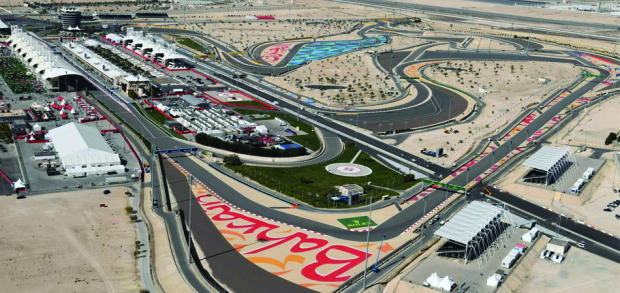
The Bahrain International Circuit (BIC) has plans for a significant transformation, including capacity expansion and enhanced environmental initiatives, according to its chief executive Shaikh Salman bin Isa Al Khalifa.
The circuit is targeting a major capacity increase, with preliminary plans to expand facilities by 2027 through 2029.
“We’ve been selling out for three years,” Shaikh Salman explained, signalling the need for additional infrastructure to meet growing demand.
A BIC official told the GDN on the sidelines of yesterday’s talk by Shaikh Salman at the AmCham Bahrain Business Networking Luncheon that the plans are in their preliminary stage at this time, since the circuit needs to ensure a top-notch experience for fans in the expanded areas, which comes with additional infrastructure requirements.
However, plans for an expansion to the Paddock Club area could kick off as early as after next year’s race, with the primary challenge being completion of construction before the following F1 race weekend.
This year, the BIC built a temporary pop-up viewing area near the existing Paddock Club for ticket-holders to the elite F1 experience, expanding its capacity by 360.
“We will hopefully expand capacity as well as our corporate boxes, and the Paddock Club by 2029, which will be our 25th anniversary,” Shaikh Salman added.
This is part of a range of investments the BIC has planned in the kingdom to boost motorsport in Bahrain and across the region.
“We invest in bringing motorsports that make sense – for example, karting, which we want to grow,” Shaikh Salman added.
“This year we have the ROTAX Max Challenge (RMC) World Finals, which is an amazing event, where about 300 go-kart drivers from all over the world, fly in and have a great week of racing.
“In the coming years, we will try to bring back the Commission Internationale de Karting World Championship for karting.
“Last time we had it, Lando Norris (McLaren) and Max Verstappen (Red Bull) were racing and now you see them at F1.”
When asked about Bahrain having a homegrown local F1 driver, Shaikh Salman acknowledged how competitive the sport is, and emphasised the need to grow the local karting ecosystem.
Pre-season testing represents another significant opportunity for economic and sporting growth.
Shaikh Salman mentioned the possibility of expanding testing periods to potentially 10 days, attracting international teams and further establishing Bahrain as a global motorsports destination.
“The idea is to continuously improve,” he said, “showing that when teams and fans come to Bahrain, they experience world-class facilities and organisation.”
Environmental sustainability also stands at the forefront of these improvement plans. The circuit has already implemented ground-breaking green initiatives, including a solar farm that currently covers F1 race weekend energy requirements.
“Phase two will start this year,” Shaikh Salman revealed, “which will cover our total energy use through renewable sources.”
He also noted that after reducing the equivalent of 100,000 single-use plastic bottles last year, this year’s race increased the environmental impact, by eliminating the use of more than 311,355 single-use plastic bottles.
This was done primarily through the provision of hydration stations across the circuit, and replacing water bottles with recyclable aluminium cans.
Top stories for today:
School probed
INDIA ATTACKS: Pakistan downs two jets after three killed
Green light for new corporate tax
&uuid=(email))