

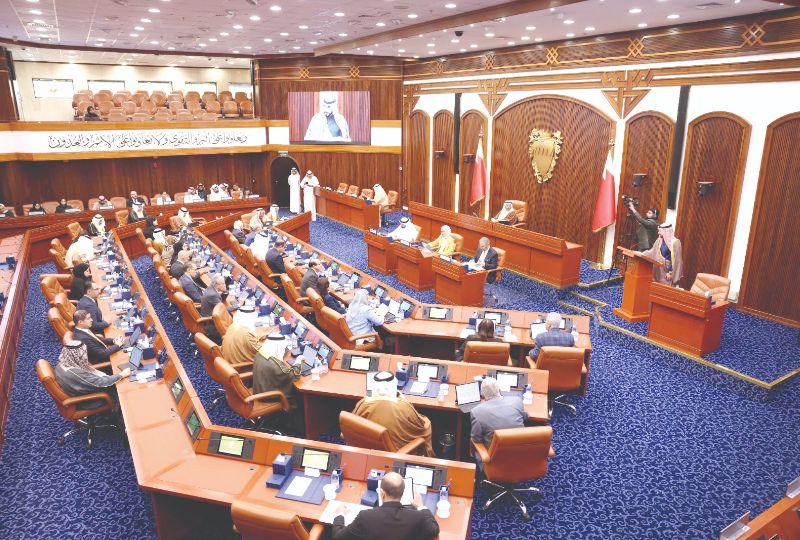
MPs have rejected the government’s 2023 closing financial statement, citing missing details and calling for greater transparency in public spending and revenue policies.
The move reflects ongoing parliamentary concerns over financial management and accountability.
MPs voted overwhelmingly against the statement during yesterday’s session, marking the latest in a series of rejections of the government’s annual budget closure reports.
Parliament has historically refused to endorse most closing statements, with the exceptions of 2003-2006 and a narrow approval in 2009. The only approval since then was for 2020, when MPs acknowledged that spending had been clearly directed toward mitigating the impacts of the Covid-19 pandemic.
“The numbers don’t tell the full story,” claimed MP Ahmed Al Salloom, chairman of Parliament’s financial and economic affairs committee. “Yes, there have been efforts to improve but efforts alone aren’t enough. Things need to be done with perfection – this process involves public money and national assets.”
The rejected statement has been forwarded to the Shura Council for further review, as required under Bahrain’s legislative procedures.
In response to MPs’ concerns, Under-Secretary for Financial Affairs at the Finance and National Economy Ministry Yousif Abdulla Humood, defended the government’s financial practices. “Loans obtained by certain public entities and institutions are not included in the government’s public debt,” he clarified.
Mr Humood reported that spending on development projects reached 85pc of allocated budgets in 2023, describing the figure as “very good” given the vital role such projects play in driving economic growth. “We must remember that implementing development projects requires a full cycle of procedures and approvals,” he added.
Regarding the government’s Fiscal Balance Programme, Mr Humood said government entities have reduced spending by up to 25 per cent since the programme’s launch in 2018.
“The process of expenditure control is proceeding in the best possible manner,” he affirmed.
He concluded by asserting that achieving a budget with no deficit would be possible if the government were to adopt tougher measures.
“However, the government has chosen to work collaboratively with Parliament to reach consensus, which has resulted in a manageable deficit that can be addressed in the coming period,” Mr Humood said.
During the debate, MP Jalal Kadhem Al Mahfoodh drew attention to longstanding infrastructure deficiencies in parts of the Northern Governorate. “Some villages in the Northern Governorate have been deprived of a sewage network for more than 50 years,” he said.
“The Works Ministry bears a significant responsibility – we understand this – but the lack of sewage services, along with frequent road accidents due to the absence of pedestrian bridges, are critical needs.”
He acknowledged the ministers’ co-operation with Parliament, but said budget constraints have delayed addressing these essential infrastructure projects.
MPs took a retrospective vote on two royal decrees to approve increasing the borrowing cap up to BD16 billion and BD18bn and forwarded both to the Shura Council.
This year it has been increased to BD22.5bn following Parliament and the Shura Council approval in March.
Top stories for today:
School probed
INDIA ATTACKS: Pakistan downs two jets after three killed
Green light for new corporate tax
&uuid=(email))