

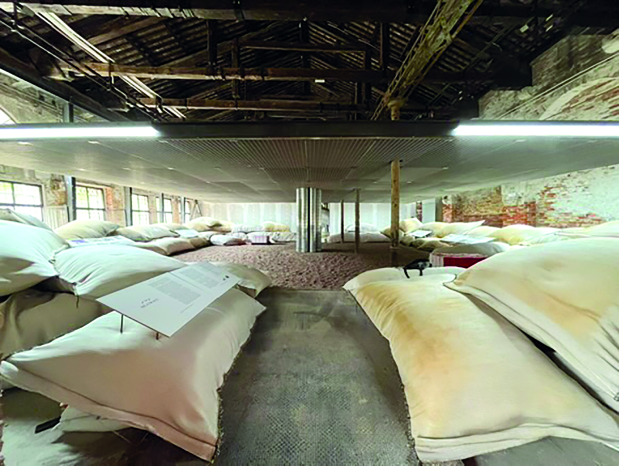
BAHRAIN’S national pavilion at the 19th International Architecture Exhibition – La Biennale di Venezia showcasing traditional solutions to modern problems in the face of climate change is set to be inaugurated in Venice, Italy today.
Located in the Artiglierie section of the Arsenale, the kingdom’s pavilion, titled ‘Heatwave’, offers an architectural proposal to the growing challenge of rising global temperatures, drawing inspiration from traditional Bahraini cooling techniques and introducing a passive outdoor cooling installation designed to promote environmental resilience and social sustainability.

A heatmap showing how much impact the canopy (represented by a blue square) could make in cooling air temperatures
“The national pavilion of Bahrain addresses these pressing issues, which threaten human health and the seasonal livability of affected areas,” the pavilion’s curator and architect Andrea Faraguna told the GDN.
“The pavilion explores public shading structures and passive cooling by drawing on research into vernacular and contemporary cooling methods and materials that naturally reduce temperatures.
“It reimagines elements of Bahrain’s architectural heritage – wind towers, courtyards and cooling techniques – through the lens of modern engineering.
“Beyond technical solutions, ‘Heatwave’ emphasises the socio-cultural importance of public spaces in mitigating climate impacts, with a special focus on construction sites and seeking to provide shade to those most affected by heat.
“By proposing adaptable, climate-resilient interventions, the pavilion envisions public spaces as vital hubs for social interaction and community cohesion, even in extreme environmental conditions.”
‘Heatwave’ marks Bahrain’s eighth participation in the biennale and was commissioned by Bahrain Authority for Culture and Antiquities president Shaikh Khalifa bin Ahmed Al Khalifa.

An interior view of the pavilion in Venice
An accompanying publication expands on the pavilion’s themes, featuring essays and technical research by contributors including Eman Ali, Abdulla Janahi, Alexander Puzrin, Caitlin Mueller, Eduardo Gascón Alvarez, Jonathan Brearley, Laila Al Shaikh, Latifa Al Khayat, Leslie Norford, Maitham Al Mubarak, Maryam Al Jomairi, Mohammad Salim, Paris Bezanis, Viola Zhang and Wafa Al Ghatam.
The structural design of the pavilion was developed by Mr Puzrin and Mario Monotti.
“Collaboration lies at the core of the project,” Ms Faraguna added.
“Engineers, architects and local practitioners have contributed their expertise to create a pavilion that seamlessly combines tradition with innovation.”

A 3-D rendition showing how the pavilion could be used in closed or open spaces
The pavilion centres around a modular outdoor cooling system that operates without mechanical air conditioning. It uses a geothermal well and solar chimney to move air through a cycle of underground cooling and vertical ventilation.
By channelling hot ambient air through pipes buried in the earth, where temperatures remain stable, the system reduces air temperature before releasing it back into public space.
Rising warm air is then extracted through the solar chimney.

A diagram of the Bahrain-inspired design, that could be adapted to Venice’s canals
The technique draws directly from Bahrain’s architectural heritage, particularly wind towers and shaded courtyards, which historically provided thermal comfort before air conditioning.
The accompanying study proposes the implementation of the system and public space in some of Bahrain’s highly dense urban areas, including Salman Town and Muharraq, offering a solution in areas where workers often spend hours in direct sun without access to air conditioned shelter.
The pavilion uses advanced materials foam carbon aluminium, carbon plaster, biochar composites and Damascus metal to enhance cooling while keeping the structure lightweight and adaptable.

View under the ventilated canopy of a construction site in Madinat Salman, Bahrain
“In Venice, once the biennale is over, the pavilion could stay within the city and be reinstalled on the Island of San Giorgio,” the study proposes.
To adapt it to the canal-rich city, the ventilation and cooling system could lower air temperatures by channelling it through adjacent water bodies, before being distributed throughout the space, almost like a large-scale air conditioner.
The pavilion responds to this year’s overarching biennale theme, “Intelligens. Natural. Artificial. Collective,” which examines how architecture engages with contemporary challenges through both natural systems and technological tools.
The exhibition will be open to the public from tomorrow to November 23 this year.
More information is available at www.bahrainpavilion.bh and on Instagram at @bah.pavilion.
naman@gdnmedia.bh
&uuid=(email))