

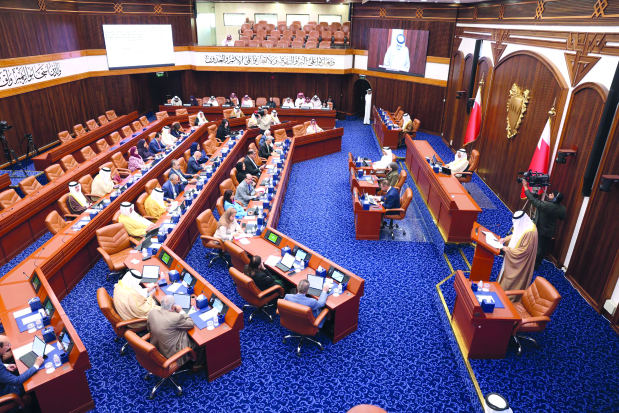
THE Shura Council ended its seven-month third session of the sixth legislative term of the National Assembly earlier this month by reviewing a record 49 legislations and addressing 23 questions directly to ministers.
During 29 regular meetings and one extraordinary meeting held throughout the third session, the upper chamber discussed three decree laws, 38 draft laws and eight legislative proposals.
It also discussed two final financial statements.
Additionally, members addressed 23 questions directly to ministers during the previous session.
The Shura Council also approved three decree laws and referred them to Parliament for notification to the government.
The council has not yet decided on any of the proposed laws. Over the years, the highest number of legislations discussed and passed by the upper chamber in any given session has been 40.
Before the National Assembly was adjourned for a five-month break on May 13, the Shura Council was discussing three other royal decrees.
Of the 38 draft laws, 30 were approved and referred to the government to be presented to His Majesty King Hamad for ratification following approval by both chambers of the National Assembly.
The council returned seven bills to MPs for reconsideration, following a thorough debate and appropriate decision-making.
In one instance, disagreement arose between both chambers on a single draft law, necessitating a joint National Assembly meeting in accordance with Article 85 of the Constitution.
Additionally, 12 draft laws remain under committee review.
The third session also saw an increased emphasis on member-initiated legislative proposals aimed at enhancing legal and legislative framework.
These included proposals to establish new regulatory structures and amend existing laws to align with the kingdom’s evolving legislative policy.
In total, the Shura Council referred seven legislative proposals to the government after discussing and approving them during the sessions.
One legislative proposal was rejected, while three proposals remain under review by special committees.
The council also approved two reports on final accounts and financial statements, while the financial and economic affairs committee continues its review of two additional statements currently under study.
In terms of its constitutional oversight role, the council exercised its right to question government ministers, submitting 23 parliamentary questions during the session.
The ministers provided responses that were formally presented in council meetings.
These questions covered a broad range of topics, including financial matters, social affairs, labour, healthcare, public services, education, the environment, and legal issues – reflecting the council’s commitment to addressing all facets of government policy and responding to public concerns.
The third session highlighted the Shura Council’s ongoing efforts to elevate legislative performance and exercise parliamentary oversight in line with the expectations and aspirations of the Bahraini people.
The five-month recess is set to end in October.
Committee chairmen are set to sit throughout to review pending legislations.
mohammed@gdnmedia.bh
&uuid=(email))