

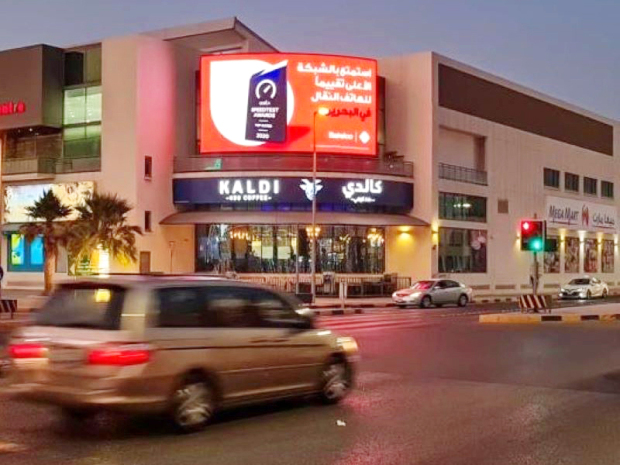
New rules are set to be introduced in Bahrain to ban advertisements at places of worship and on historic buildings (including surrounding walls), public buildings dedicated to public services, memorials, public parks, sidewalks, trees, road surfaces, traffic roundabouts, islands or intersections.
The amendments to the 1973 Advertisements Law, referred by Municipalities Affairs and Agriculture Minister Wael Al Mubarak, have been unanimously approved by the Capital Trustees Board.
With the proposed amendment, advertising on public buildings or parts of them will now be permissible provided it complies with ministerial regulations yet to be issued.
The amendments, which will be debated in Parliament in October, following the legislative recess, introduces crucial changes to the long-standing decree, particularly regarding advertising on public buildings.
Additionally, the amendment seeks to keep pace with technological advancements in the advertising sector, including digital and electronic billboards, to ensure Bahrain’s advertising legislation remains modern and adaptable.
The board’s financial, administrative and legislative committee chairman Dr Abdulhassan Al Dairy emphasised that the proposed amendment was necessary to balance urban aesthetics with evolving commercial practices.

Dr Al Dairy
“Our primary objective is to reinforce co-ordination between the legislative and executive authorities, including municipalities and the Capital Trustees Authority, to ensure any amendments to advertising laws are applied effectively,” Dr Al Dairy explained.
“It’s not just about adding restrictions, it’s about ensuring the urban identity and architectural beauty of our cities are preserved while embracing modern advertising trends.
“One of the most significant updates allows advertising on public buildings or parts of them, but only in accordance with regulations, conditions, and guidelines to be determined by a ministerial decision.
“This provision provides flexibility,” Dr Al Dairy added.
“It allows us to use certain public spaces for advertising in a controlled, regulated manner, preventing chaos while opening up opportunities for municipalities to generate revenue.”
He highlighted eight primary goals behind supporting the draft amendment, including:
* Protecting urban landscapes and identity,
* Enhancing citizen safety, especially by regulating advertisement placements that may obstruct drivers or cause visual clutter,
* Strengthening municipal oversight, giving local authorities greater power to monitor compliance,
* Generating municipal revenue through fair, regulated advertising licenses, and
* Curbing illegal and random advertising, ensuring fairness in commercial competition.
“It is essential that advertising activities do not undermine the rights of legitimate businesses that go through proper licensing channels,” Dr Al Dairy stressed.
“Random, unlicensed advertisements have become a burden on our urban spaces and disrupt fair competition.”
Board vice-chairwoman Khulood Al Qattan also expressed her full support for the proposed amendment, underscoring the need to eliminate legal loopholes and provide clear enforcement mechanisms.
“Having clear, up-to-date legal provisions will significantly reduce legal disputes,” Ms Al Qattan said.

Ms Al Qattan
“It will also give enforcement agencies the power they need to regulate advertising responsibly while giving clear guidance to businesses.”
She further pointed out that the move reflects the board’s broader strategy to enhance urban governance and align municipal laws with Bahrain’s Vision 2030 goals.
“The control mechanisms will be introduced by executive decision,” Dr Al Dairy clarified.
“This ensures oversight while giving room for responsible advertising to contribute positively to municipal finances.”
Ms Al Qattan expressed confidence that legislators would recognise the importance of the amendment’s role in modernising outdated legislation and boosting municipal financial resources.
“We expect Parliament to work with us to finalise this crucial update,” she stated.
“Advertising can be a win-win for both public spaces and the national economy, but only if done right, within a clear and fair legal framework.
“As Bahrain continues its economic diversification and modernisation drive, the update to the advertising law is seen as a key step towards aligning urban governance with contemporary commercial practices.”
mohammed@gdnmedia.bh
&uuid=(email))