

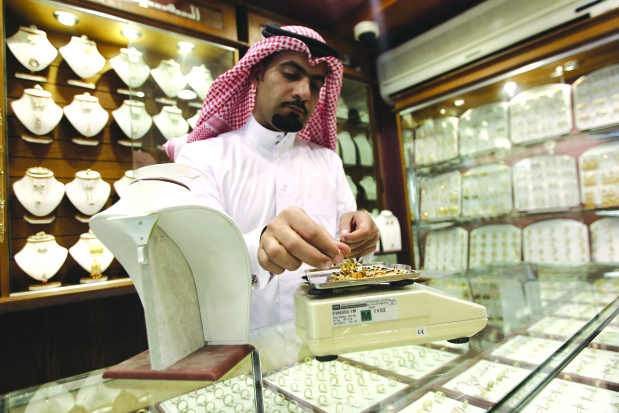
AN urgent and co-ordinated government action is needed to revive Bahrain’s gold sector, according to a top businessman.
Describing the sector as a ‘national economic and cultural treasure’ that has been overlooked for far too long, Bahrain Businessmen’s Association vice-chairman Abdulhakim Al Shammari emphasised that Bahraini gold continued to have a strong reputation across the GCC for its craftsmanship and authenticity.
However, he warned that institutional neglect over the years has resulted in missed opportunities to elevate ‘Bahraini Gold’ into a globally recognised national brand.
He stated that despite consumer trust, especially within GCC markets, the sector lacks the structural and financial support required to grow and sustain its presence both locally and internationally.
He also outlined several key challenges hindering the sector’s development.

Mr Al Shammari
“There is an absence of a dedicated institutional framework to promote and protect the ‘Bahraini Gold’ label,” said Mr Al Shammari.
“Limited international marketing efforts and weak participation in global and regional trade fairs are also factors.
“A lack of specialised industrial zones for gold workshops have resulted in arbitrary fines and workshop closures by relevant authorities.
“Additionally, despite regional agreements, trade barriers in neighbouring markets have caused ‘Made in Bahrain’ gold products to face import duties.”

Bahraini gold continues to have a strong reputation across the GCC for its craftsmanship and authenticity
Bahraini gold is known for its high purity. It is available in various karats including 24K, 22K, 21K, 18K and 14K.
Out of all the options, 24K gold is considered the purest, with a fineness of 99.9 per cent. The kingdom has a system where all gold items are tested and hallmarked before being sold, ensuring they meet the purity standards.
There is a strong demand for Bahraini gold, particularly among customers from the GCC countries who come to the kingdom to purchase jewellery for important events such as weddings.
According to Sijilat, an integrated online commercial registration (CR) portal, there are currently around 200 active commercial establishments that deal in gold products.
Mr Al Shammari stressed that unlike sectors such as tourism, heritage and sports, the gold sector has not benefited from co-ordinated government backing.
He called on four key ministries to take immediate and specific steps.
He recommended that the authorities regulate licences for gold workshops to balance supply and demand and prioritise 100 per cent Bahraini ownership while encouraging foreign investment.
“The Industry and Commerce Ministry should look at establishing a national training centre for young Bahrainis in jewellery design, production and traditional gold craftsmanship,” he said.
“Bahraini gold should also be officially registered as a national brand, certified for quality and origin.
“The ministry should also facilitate financing gold-related small and medium enterprises through banks and development funds.”
For the Tourism Minstry, he recommended integrating gold markets and manufacturing sites into heritage tourism itineraries, and marketing gold suqs as unique cultural destinations for regional and international tourists.
He believes that launching global promotional campaigns positioning Bahraini gold as a symbolic heritage gift, and organising annual events such as a Bahraini Gold Week will stimulate local sales and tourist engagement.
The Municipalities Affairs and Agriculture Ministry, he said, could create designated ‘Gold Districts’ with modern infrastructure and relocate workshops from unregulated areas into the planned zones.
Finally, the Finance and National Economy Ministry can secure Customs exemptions for Bahraini gold in GCC markets and eliminate exhibition taxes until actual sales occur.
Mr Al Shammari stated that providing financial and logistical support for Bahraini exhibitors at international trade events and reducing export-related fees could help revive the sector.
“Bahraini gold is more than a product – it’s a national symbol, part of our collective economic memory,” he said.
“If we continue business as usual, we risk losing this heritage to regional competition.
“But with a unified national initiative and ministerial co-ordination, Bahrain can re-establish itself as a regional hub for authentic gold craftsmanship.
“We have the talent, the tradition and the trust. What we need now is unified national will.”
According to a Reuters report last month, gold prices edged up as tensions in the region boosted safe-haven demand, with investors buying gold as a way to protect their wealth.
A low-interest-rate environment and geopolitical uncertainty boosted gold’s appeal not just in the region, but around the world.
This is because gold is often seen as a reliable store of value that can withstand market downturns and economic instability, unlike other assets that may be more vulnerable to fluctuations.
nader@gdnmedia.bh
&uuid=(email))