

A LONG-ANTICIPATED push to restore the maritime livelihood of Demistan has taken a decisive step forward, with the site of a proposed port officially included in Bahrain’s National Plan for the Development of Marine Harbours, according to a formal response from the Supreme Council for Environment’s Marine Wealth Directorate.
The announcement was made by area councillor and a member of the Northern Municipal Council Zainab Al Durazi who has been at the forefront of efforts to re-establish Demistan’s role as a vibrant coastal community.
Her proposal, which advocates for the construction of a fully equipped harbour on government-owned coastal land, was last month approved unanimously by the council and forwarded to the relevant national authorities.
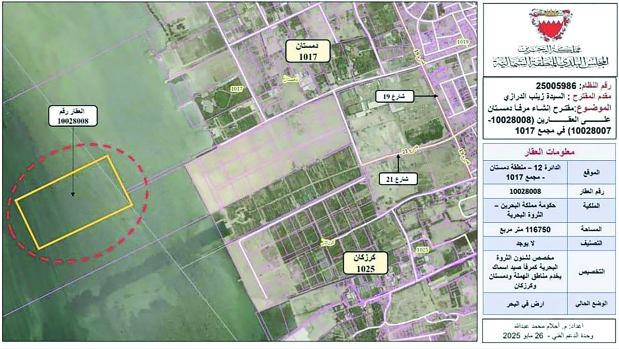
The proposed project site as stated in the response is in Block 1017.
“Demistan is not just a village, it is a living archive of Bahrain’s maritime identity,” Ms Al Durazi told the GDN.

Ms Al Durazi
“For generations, its people have depended on the sea, and this harbour is a promise to revive and protect that legacy.”
For years, residents of Demistan – a historic village located along Bahrain’s western coast – have expressed frustration over the absence of proper maritime infrastructure.
Despite being traditionally reliant on fishing and seafaring, the village has lacked even basic harbour facilities, forcing many local fishermen to dock at distant ports or abandon the trade altogether.
“It’s painful to witness seasoned fishermen struggling to maintain their livelihoods because they lack a proper place to anchor their boats or sell their catch,” said Ms Al Durazi.
“The community has repeatedly raised this issue, and it was imperative that we act.”
Ms Al Durazi submitted a comprehensive proposal to the council, requesting the construction of a harbour on two adjacent government-owned plots of land situated directly on the Demistan shoreline.
The properties are registered under the Marine Wealth Directorate and, as she pointed out, offer an ideal location due to their strategic position on the western coastline, which overlooks important fishing zones and serves as a natural access point for small vessels.
The proposal cited not only the social and historical value of the site but also the potential for economic revival and coastal tourism.
According to Ms Al Durazi, the project could also attract investments in ancillary sectors such as seafood processing, eco-tourism and artisanal markets.
The breakthrough came in the form of an official letter from the Director General of Marine Wealth, who confirmed that the site had been formally listed in the national plan, which aims to modernise and expand Bahrain’s network of small harbours to serve both commercial and community needs.
“We were encouraged by the Director General’s response, which affirms that Demistan is finally on the national radar,” Ms Al Durazi stated. “This is more than a procedural step; it is recognition that the needs of smaller, historically marginalised villages matter.”
However, she clarified that while inclusion in the national plan marks significant progress, execution of the project still hinges on final approvals from higher government authorities, as well as integration into upcoming phases of the national maritime budget and implementation schedule.
“We are aware that the implementation phase involves several government bodies – including planning, finance and infrastructure agencies – but the foundation has been laid,” she said.
“Our role now is to ensure continued co-ordination, advocacy and public engagement until we see cranes on the ground and boats in the water.”
The Demistan harbour proposal aligns with broader national objectives outlined in Bahrain’s Economic Vision 2030, which calls for sustainable use of the kingdom’s marine resources, inclusive development and enhanced support for traditional sectors.
“We are not just building a port, we are building economic resilience,” said Ms Al Durazi.
“This project offers a lifeline to our fishermen, empowers local youth with new opportunities and adds value to the national economy by reviving a sector that is both culturally significant and economically underutilised.”
She also highlighted the environmental stewardship aspect of the project.
The proposal includes environmentally sensitive construction practices, waste management mechanisms and habitat protection measures in line with the guidelines of the Supreme Council for Environment.
“Preserving marine biodiversity and respecting ecological limits will be central to the harbour’s design,” she said.
“We want a facility that honours the past, serves the present and sustains the future.”
Public support for the project in Demistan has been overwhelming.
Local elders, fishermen and families have actively supported the proposal through petitions, community meetings and municipal hearings. Many see it as an opportunity to preserve heritage, reverse youth migration from coastal areas and provide tangible public benefit through infrastructure that reflects the community’s identity.
“It is unacceptable that a village so intertwined with Bahrain’s maritime past has no port today,” one elderly resident told the GDN.
“We don’t need promises; we need foundations poured, docks built and boats returning home.”
mohammed@gdnmedia.bh
&uuid=(email))