

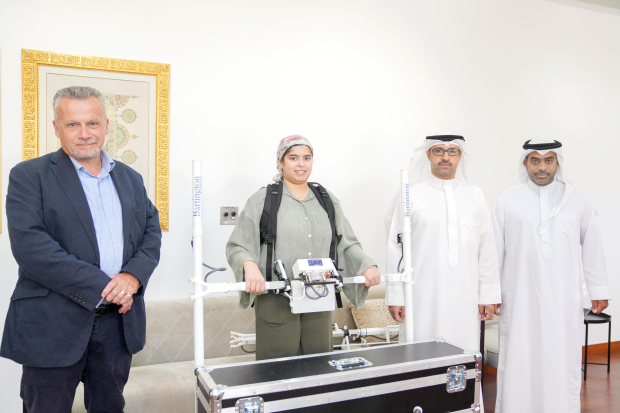
A British archaeology lover has donated a state-of-the-art scientific instrument to Bahrain Authority for Culture and Antiquities (Baca) to help uncover the secrets that lie below Bahrain’s sands.
The device, a magnetometer, will enable archaeologists to take a look into the earth and discover buried structures and objects without digging in the site or disturbing the soil.
The high-tech magnetic survey instrument was donated to Baca by Londoner Dale Buxton, and was presented to the authority by the head of the British Expedition in Bahrain, Dr Timothy Insoll.
According to Baca director general of antiquities Dr Salman Al Mahari, who received the gift at the Bahrain National Museum, the device will soon be deployed in an historical site near Qal’at Al Bahrain.
“The device will be used for specialised prospection and surveying,” Dr Insoll, who is a faculty member at the Institute of Arab and Islamic Studies (IAIS) at Exeter University, told the GDN.
“This is a machine that’s ideal for the conditions of Bahrain, where the soil is high in salt content. It gives you the ability to look below the ground, about 1m to 1.5m, without digging.
“It will allow us to search for the tops of walls, without disturbing graves or other features, and will facilitate rapid survey work in advance of building projects.”
He stated that, since excavation is costly and time-consuming, archaeologists can avoid the expenses by scanning and mapping sites, and then choosing which areas to dig.
He gave the Christian site in Samaheej as an example, as it was located in the middle of a cemetery that is currently in use by the locals of the village.
Baca archaeology researcher Mashael Alshamsi told the GDN that she and her team plan to use the device to look for a missing link in the Hilla Site, named after the village of Hillat Abdul Saleh.
“Last year, the excavations at Hilla have shown us a Middle Dilmun collective burial, with some very beautiful, interesting finds,” the Exeter University alumna stated. “We found two kohl applicators, two rings, over a thousand beads, and a beautiful faience mask. Above that was mostly Islamic remains, and on another side of Hilla, we have a Tylos burial.
“We have found a great variety of historic periods at Hilla, and we assume they’re all connected to Bahrain Fort’s layers, because of the proximity to the site. We want to look for more because of how rich the finds are.”
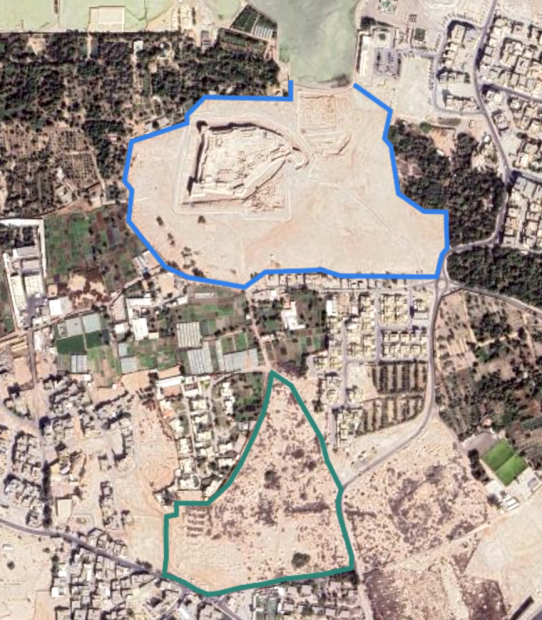
The Hilla Site, bottom, with the Bahrain Fort site, top
She hopes to find Late Dilmun remains or burials to connect the Middle Dilmun and Tylos layers, she explained.
Mr Buxton told the GDN that he was happy to support ongoing archaeological work, to further educate the world on Bahrain’s importance in history.
“From my very first visit to Bahrain, the hospitality and kindness of the people captivated me, as it has visitors for thousands of years,” he said.
“From the beginning of human culture, Bahrain has been a place of significance. It was not only known for the pearl trade, but also as a gateway between Mesopotamia, the Indus Valley, the Arabian Peninsula and all the way to Africa.
“The citizens should be proud of their history.”
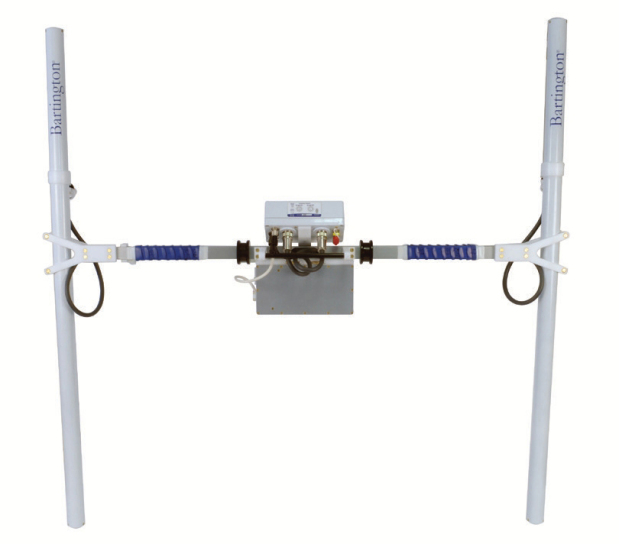
The Bartington Grad601 magnetometer
The device is a Bartington Grad601 magnetometer, made by UK-based Bartington Instruments. It can be carried by one surveyor, who walks in a zig-zag pattern across a targeted area to map it.
It uses two high-precision magnets, mounted a fixed distance apart, to measure the small changes in the Earth’s magnetic field between the two points, caused by underground features.
Besides archaeological prospecting, the instrument, which costs just under BD5,000, is used for forensic work, and to find underground pipes, along with the detection of unexploded bombs or mines.
Its lightweight, portable design enables efficient fieldwork while delivering precise magnetic gradient measurements
Last year, Baca held an activity named the ‘Ancient Pottery Quest’, in which volunteers helped experts survey the Hilla Site by hunting for pottery shards, beads and glass artefacts on the surface of the soil.
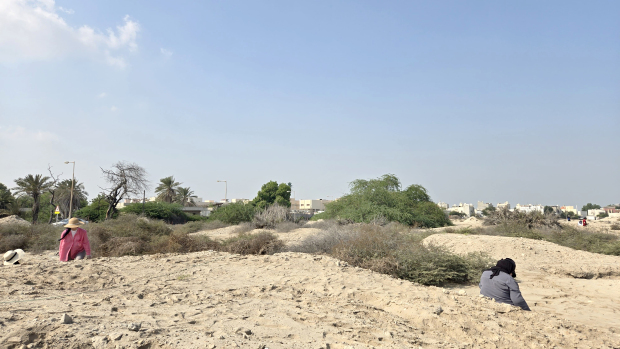
The Hilla Site
Participants were supplied with bags to gather the relics and were able to witness archaeologists’ first-hand as they cleaned, sorted and identified the pieces.
The GDN reported in January that Dr Insoll was awarded the Officer of the Most Excellent Order of the British Empire (OBE) for his services to archaeology in the kingdom and UK-Bahrain relations.
An expert in the archaeology of rituals and religions, with particular specialism in sub-Saharan Africa, the Arabian Gulf and Arabian Peninsula, he is Al Qasimi Professor of African and Islamic Archaeology and founder and director of the IAIS’s Centre for Islamic Archaeology.
His research team, including colleagues from Bahrain, uncovered one of the earliest Christian buildings (in Samaheej) in the Arabian Gulf in Bahrain in 2019 – the first physical evidence of a long-lost community there who were followers of the Church of the East, sometimes also called the Nestorian Church.
zainab@gdnmedia.bh
&uuid=(email))