

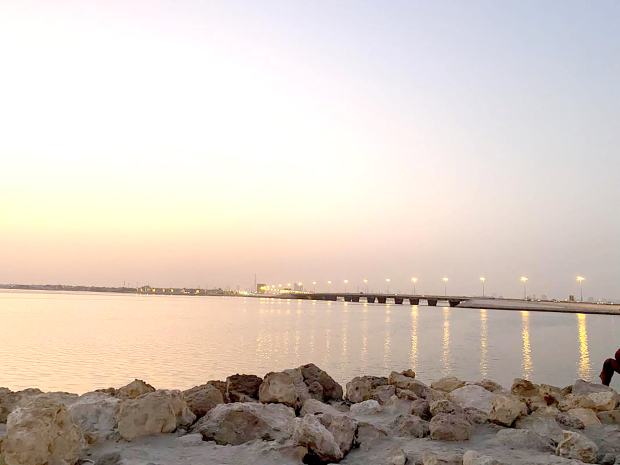
A major push has been launched to use treated sewage water from the North Sitra Sewage Treatment Plant to irrigate public parks, streets and green spaces across Sitra Island.
The initiative, spearheaded by Capital Trustees Board’s services and public utilities committee chairman Mohammed Tawfiq Al Abbas, is designed to expand green cover, reduce reliance on groundwater and strengthen Bahrain’s environmental credentials.
“The North Sitra plant already provides 16,500 cubic metres of treated water daily to cover the Manama Ring Road, Sitra Corniche and Nabih Saleh,” explained Mr Al Abbas.
“Once the expansion is complete next year, its output will nearly double to 30,000 cubic metres per day, creating the perfect opportunity to extend irrigation networks into Sitra Island itself. This will not only sustain existing trees and parks but also support new afforestation projects.”
Work on the expansion of the North Sitra Sewage Treatment Plant is already under way, with completion expected by late 2026 at a cost of BD12.8 million.
Once fully operational, the facility will play a central role in supporting Bahrain’s water management strategy and enhancing the country’s green footprint.
Mr Al Abbas stressed that the proposal was consistent with Bahrain’s Water Resources Strategy and the government’s commitment to double the number of trees by 2035, as well as its pledge to achieve carbon neutrality by 2060.

Mr Tarradah
According to the proposal, several key areas in Sitra stand to benefit immediately.
These include Roads One and Four, Sitra Grand Park, Ibn Al Nafees Park, Abu Al Aish Park, Markouban Park, Al Qarya Park and Awal Park.
In addition, a future phase could extend irrigation to Salman Al Fateh Avenue, a wide network of residential roads, four more public parks and up to 18 village playgrounds.
“This is not just about adding more greenery,” Mr Al Abbas added.
“It is about improving quality of life. Children and families will have shaded areas to enjoy, streets will become cooler in summer, and the overall environment of Sitra will be uplifted.”
Board chairman Saleh Tarradah highlighted the national investment that has already gone into upgrading the North Sitra station with cutting-edge technology.
“Bahrain has spent millions to ensure the plant can produce safe, high-quality treated water. It makes no sense to allow that potential to go underused,” he said.
“Groundwater levels are depleting rapidly. We must be smarter in how we use alternative resources. Diverting treated water to irrigation is both sustainable and cost-effective.”

Capital Trustees Authority director-general Mohammed Al Sehli, left, with Mr Al Abbas
He also underscored the economic dimension of the project.
“Well-maintained parks and green areas attract visitors, raise property values and make neighbourhoods more desirable places to live. Green planning is not a luxury; it is an investment in social and economic well-being,” Mr Tarradah noted.
Municipal officials have also flagged the damage caused to existing crops and trees in Sitra due to a lack of reliable irrigation.
The proposal aims to ensure that such greenery does not wither away, while creating the conditions to plant thousands of new trees.
“This is a practical, realistic step that will deliver results for both the environment and the people,” said Mr Tarradah.
“If we want to talk seriously about sustainability, then this is exactly the kind of project that turns vision into reality.”
mohammed@gdnmedia.bh
&uuid=(email))