

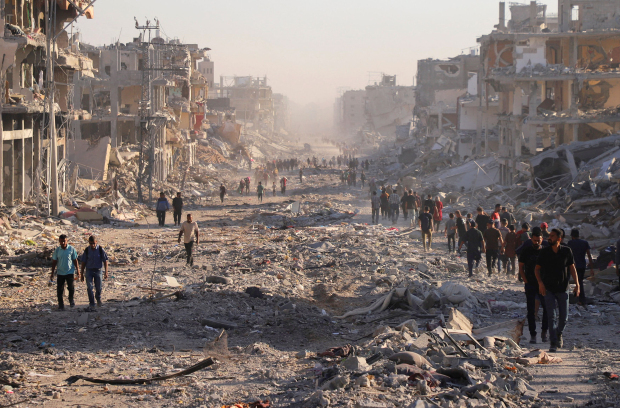
Thousands of Palestinians began the long, dusty walk from the south of Gaza towards Gaza City after a ceasefire came into effect in the enclave yesterday. They found their city lying in ruins – yet were relieved to be returning home.
Virtually the whole population of northern Gaza had been displaced since Hamas’ attack on October 7, 2023, led to Israel’s war in the enclave, and the area has been reduced to rubble over the past two years.
Aerial footage shows vast stretches of land with nothing but ruins. There’s no infrastructure, no electricity and no running water.
Yet for many of those making the trek yesterday, there is no question about returning.
“I pray that God relieves our sorrow and distress and that people return to their homes. Even if the houses are destroyed, we will return, God willing,” said Ahmad Abu Watfa.
Abu Watfa was on his way back home to Sheikh Radwan in Gaza City. He said he was feeling an overwhelming joy, even though he knew that it’s likely that nothing awaits him that he could call home.
“There is no feeling more beautiful than this – the feeling of people returning from the south to the north,” he said.
An Israeli Defence Forces (IDF) spokesperson said that people were allowed to move from the south to the north via the coastal Al Rashid Street and the Salah Al Din Road in the center of the Gaza Strip.
For many residents of northern Gaza, yesterday marked the second time they tried to return home. While Israel forced most residents of northern Gaza to leave the area early in the war, it briefly allowed people to return to some parts during the last ceasefire in January.
But that homecoming was short lived for most, as Israel once again ordered a complete evacuation of Gaza City in early September, ahead of a ground invasion into the city.
The IDF said at that time that 640,000 people had left the city after the evacuation order. That number represented about 90 per cent of Gaza City’s pre-war population, although it was not possible to verify that estimate.
The situation in Gaza City was critical even before that ground offensive, with no fully functioning hospitals and few places to shelter.
Yesterday, medical teams from the Al Rantisi hospital in Gaza City returned to the facility to find it completely destroyed. Gaza’s deputy minister of health, Dr Yousef Abu Al Rish, shared a video from the scene that showed ruins and burned and destroyed medical equipment.
The Integrated Food Security Phase Classification, a United Nations-backed initiative, said that famine took hold of Gaza City in August and has since spread to the rest of the strip.
As people began to return to the north, grim discoveries awaited them there. Footage from the city shows many multistory buildings completely flattened and others ripped apart by blasts. The whole area appears to be covered in grey dust, with mostly no other color visible.
Mohammed Abu Salmiya, the director of Al Shifa hospital in the north, said that the bodies of at least 33 Palestinians have been recovered from Gaza City yesterday, after the Israeli military withdrew from some areas of the city.
He said that it was impossible to identify some of the bodies, which is why they were sent to the hospital where forensic teams could examine them.
Majdi Fuad Mohammad Al Khour was standing amid the rubble of what used to be his house in Tal el Hawa.
He said two of his children – a son and a daughter – were killed in the war. His house was destroyed and nearly everything he ever owned is gone.
“Forty years of work to build this home,” he said. “I am 70 years old now. Since I was 10, I worked until I could marry, build this house, and have children. Now I cannot work, and my health does not allow me to. Where should I go? My health is no longer what it was when I was young. I am old and sick, and I cannot work. My wife is also sick and cannot see with her eyes.”
&uuid=(email))