

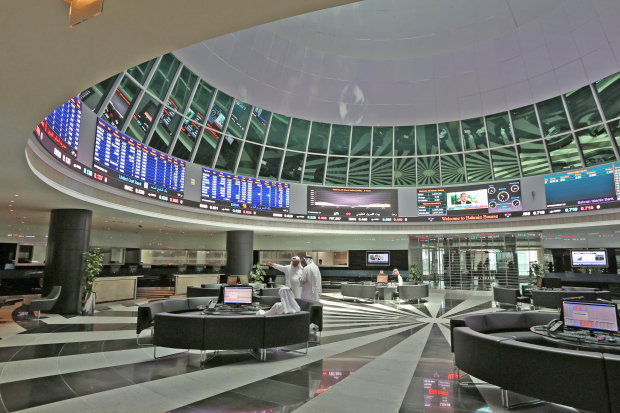
The Bahrain All Share Index rose sharply yesterday, closing higher for the day despite a marginal dip in the Islamic Index, as trading was heavily concentrated in key financial and industrial stocks.
The index closed at 1,991.99, posting a gain of 15.36 points (0.78 per cent) compared to its previous closing. In contrast, the Bahrain Islamic Index saw a slight decrease of 0.71 points (0.08pc), closing at 946.28.
The bourse saw a total trading volume of 5,478,502 shares, executed through 131 transactions. The total traded value reached BD1,519,718.
The financial sector was the primary focus of investors, accounting for 62.06 per cent of the total traded value, amounting to BD943,204. Financial sector stocks traded 4,676,729 shares through 72 transactions.
Stock prices for 14 companies were traded yesterday. Of these, 4 companies registered price increases, while two companies saw their prices decline. The remaining companies maintained their previous closing prices.
Trading was overwhelmingly dominated by two stocks: GFH Financial Group (GFH) and Alba.
GFH Financial Group took the top spot, contributing nearly half of the day’s total trading value at BD749,117.64. This value represented 49.29pc of all traded shares, with a volume of 3,799,373 shares traded across 46 transactions.
Alba secured the second spot, accounting for 31.22pc of the total value at BD474,380.75. Alba traded 497,179 shares through 40 transactions.
Al Salam Bank followed in third place, contributing 10.54pc of the total trading value, reaching BD160,233.58.
The top three companies alone accounted for 91.05pc of the total traded value. Other actively traded companies included Beyon at 1.83pc.
l Gold and silver prices hit a pause after record highs last week. Friday’s pullback was short-term profit-taking, not a change in core market drivers, said Saxo Bank’s head of commodity strategy Ole Hansen.
Gold peaked near $4,380 per ounce and silver about $54.48 before correcting. Both metals remain in a strong year-to-date uptrend (up 60pc-80pc), supported by central-bank buying, ETF demand, and a wider shift away from fiat-currency risk.
The moves highlighted liquidity gaps. Hansen noted that thinner depth in silver and platinum amplifies rallies and corrections, making prices highly sensitive to small order shifts.
Gold’s resilience stems from declining faith in traditional finance, persistent central-bank accumulation, and demand from Western ETFs and Chinese households. Hansen targets $4,000-$4,100 as a “normal corrective zone,” with potential upside towards $4,500.
Silver faces risk from the US Section 232 tariff investigation on critical minerals. Tariffs could tighten supply and boost prices; avoiding them may ease tightness.
Platinum will likely see sharp moves due to its thin liquidity and supply constraints from South Africa, though gold will provide support.
Near-term catalysts include post-Diwali Asia demand, fund flows, US real yields, dollar dynamics, and the Section 232 outcome. These factors will determine if the pause becomes a deeper correction or a healthy consolidation within the structural bull market for tangible assets, Hansen concluded.
l For the first time since 2011, Bitcoin may end the year neither as the top nor bottom performer on the asset leaderboard, a sign of its potential maturity, according to eToro Market Analyst Sam North.
Historically, Bitcoin defined annual extremes, with swings often exceeding 50 per cent in either direction.
In 2025, however, gold has taken the lead, poised for a nearly 60pc gain, its strongest rally since 1979. This rare leadership flip is driven by persistent inflation, falling interest rates, and a weaker US dollar, which have revived traditional hedges, North said in a commentary.
While both assets participate in the broader ‘debasement trade’, ‘a flight from depreciating currencies’ gold has become the standout performer, buoyed by central bank buying, retail demand, and a search for safety amid global uncertainty. Bitcoin’s explosive upside, meanwhile, appears to be moderating as its liquidity deepens.
The question is whether this marks a temporary flip or a long-term shift. Bitcoin’s diminishing percentage returns are natural as its market expands, but gold’s outperformance in a year defined by currency debasement is significant. North noted that all major asset classes are in the green for the first time since 2019.
The divergence suggests investors may be rediscovering tangible stores of wealth, or that Bitcoin’s role is shifting from a volatile asset to a more established one. North concluded that while both will serve as hedges against monetary excess, Bitcoin may no longer be the undisputed leader.
avinash@gdnmedia.bh
&uuid=(email))