

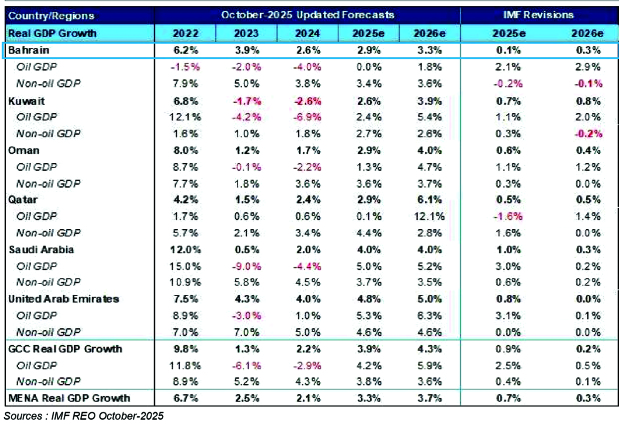
Bahrain is set for stronger economic performance in 2025 and 2026, according to the International Monetary Fund’s (IMF) latest Regional Economic Outlook (REO), which highlights broad resilience across the GCC region.
The kingdom’s real GDP growth forecasts have been revised upward for both the current and coming year, primarily driven by a boost in the oil sector following the earlier-than-expected unwinding of voluntary production cuts by Opec+.
The 2025 real GDP growth forecast is 2.9 per cent, an upward revision of 0.1pc and the 2026 real GDP growth forecast is 3.3pc, an upward revision of 0.3pc.
For context, the actual real GDP growth was 6.2pc in 2022 and 3.9pc in 2023, shows analysis by Kamco Invest.
Bahrain’s oil GDP outlook received a significant uplift, with the 2025 forecast revised up by a substantial 2.1 percentage points (bps) and the 2026 forecast by 2.9bps to 3.3pc. This sectoral rebound offsets a slight downgrade in the projected non-oil GDP growth for both years.
Despite the positive growth revisions, the IMF expects Bahrain to continue running a fiscal deficit of negative 10.7pc of GDP in 2025 and negative 9.9pc of GDP in 2026, contrasting with the projected overall surplus for the GCC bloc.
Bahrain’s improved outlook is part of a wider trend across the region, which has shown remarkable resilience despite a year marked by tariffs, geopolitical tensions, and conflict. The IMF upgraded the growth outlook for all six GCC countries.
Real GDP growth outlook for the GCC as a whole was revised up by 90bps to 3.9pc for 2025 and by 20 bps to 4.3pc for 2026.
The entire GCC oil sector saw a sharp 250 bps increase in its 2025 outlook to 4.2pc, thanks to the Opec+ decision. The GCC non-oil sector outlook was also raised, underscoring strong domestic demand and ongoing diversification projects across the Gulf.
For the broader Mena region, the IMF raised its 2025 forecast by 70bps to 3.3pc and its 2026 forecast by 30bps to 3.7pc, supported by declining global energy and food prices.
However, the IMF noted that risks to the regional outlook remain tilted to the downside, with threats including lagged effects from global uncertainty and a sharp tightening in global financial conditions that could dampen consumption. Inflation across the GCC is projected to remain stable and moderate, at or below the 2pc target for the coming years.
avinash@gdnmedia.bh
&uuid=(email))