

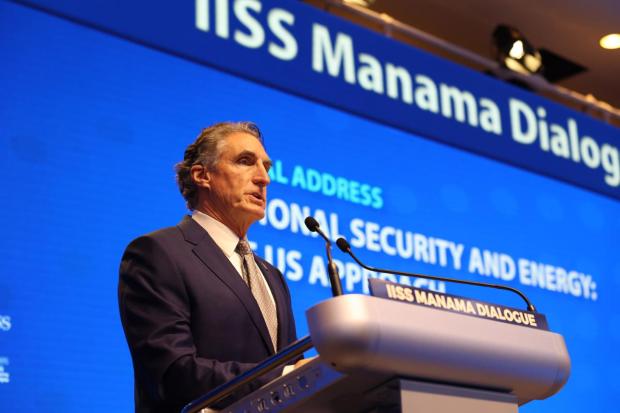
The Trump Administration sees the current era as one of ‘energy addition, not energy transition’ and is seeking to be ‘energy-dominant’, while also adding that the opportunity for more US alliances with the GCC has never been greater.
This was amongst the key points made by the US Interior Secretary Doug Burgum during a special address on the second day of the International Institute of Strategic Studies (IISS) Manama Dialogue, taking place at the Ritz-Carlton, Bahrain.
“We have an understanding that right now we’re in a period of massive energy addition – there is no transition, but energy addition,” Mr Burgum noted in his remarks during the session titled ‘National Security and Energy: The US Approach’.
“We need more energy in the world to power prosperity. We need more energy in the world to fuel artificial intelligence (AI). And we certainly need more energy for those in the world that don’t even have access to the basic things like electricity today.”
Mr Burgum spoke of the US government’s priorities in establishing the National Energy Dominance Council (NEDC).
The NEDC has listed, amongst its priorities, the development of crude oil, natural gas, lease condensates, natural gas liquids, refined petroleum products, uranium, coal, biofuels, geothermal heat, while also exploring safe ways to use nuclear energy for electricity generation.
In addition, President Donald Trump has stated that the NEDC’s goal will be “to make America energy dominant.”
When asked if this would put the US at odds with GCC countries in competing to supply energy, he noted that with the advent of AI, the energy demand around the world would be skyrocketing.
He clarified that the US’ stance was ‘not about dominating another nation.’
“It is about having the energy to not be dependent, and be able to sell energy to its friends and allies” he added.
“There is so much demand for energy needed to power AI.
“A kilowatt of electricity is worth more today than it ever has been in human history. A kilowatt of electricity, now, can not only turn on the lights in a beautiful room like this, heat a home or help move a car, but you can convert it directly into intelligent software.
“During my lifetime, this has been the one thing that has transformed human capability more than any other invention.
“It’s something that’s extended the capability of human mind. And now with AI, where we can not only just develop products, we have software that can actually develop code and can start solving problems on its own, or problems that we direct it to solve.”
Mr Burgum also noted that the ‘opportunities for alliances with the US have never been greater’, adding that the US was exploring collaborations with Saudi Arabia to work collectively on nuclear energy generation.
He revealed that ‘significant announcements and, hopefully, even an agreement’ in nuclear energy would be made when Saudi Crown Prince and Prime Minister Prince Mohammed bin Salman bin Abdulaziz Al Saud visits the US on November 18.
“President Trump signed four executive orders around nuclear earlier this year,” he noted. “Since then, there’s been a record amount of capital flowing back into this industry.”
Mr Burgum pointed to Mr Trump’s visit to the region in May this year, his first major international visit in his second term, as evidence of ‘interest in the region speaking for itself’.
The US diplomat’s remarks indicated a change in an energy stance away from renewables towards fossil fuels and nuclear energy, in a marked change from the previous US administration, while also noting that ‘peace and prosperity’ without external intervention remained the Trump administration key priority.
While noting that the Trump administration is ‘not ideologically against wind and solar’, he noted that the administration opposed ‘spending taxpayer money through the roof to subsidise forms of electricity that don’t work when the sun’s not shining, the wind’s not blowing’, adding that the US was looking to build alliances that would reduce its reliance on China for critical minerals – rare earth metals which are necessary for building batteries to store energy.
“Energy is not a separate industry,” he explained. “Energy is the basis of all other industries. It’s in the clothes we wear, the cars we drive, the food we eat, and having affordable energy prices is the key to prosperity.”
&uuid=(email))