

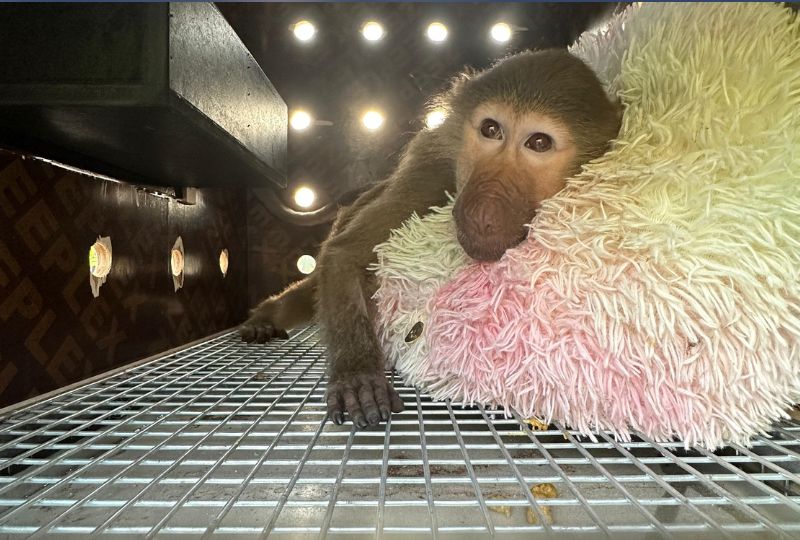
Two rescued baboons have been flown from Bahrain to a sanctuary in Djibouti, after animal rights activists in the kingdom came together to help rehabilitate them.
Saadoon, a young male whose rescue and recovery journey captured hearts across the Bahraini community and internationally, received intensive care from Bahrain Rescues for more than a year.
He was rescued in February last year at just three months old after being abandoned.
The volunteer-run unregistered animal welfare group Bahrain Rescues documented Saadoon’s journey on social media, with thousands following his progress and contributing generously to his medical care and relocation preparations.
“After more than a year and a half of caring for Saadoon and working to secure his safe passage home, this moment feels like a dream come true,” Bahrain Rescues founder Eman Eid added.
“Flying alongside him and seeing him finally arrive in an environment suited to his needs has been overwhelming.
“We are grateful to the authorities in Bahrain and DHL, whose support enabled us to return Saadoon back to where he belongs.”
Joining Saadoon was a companion – a female baboon housed at Al Areen Wildlife Reserve – and both flew on board a DHL Express flight to Djibouti, on the Horn of Africa. It is a mostly French and Arabic-speaking country of dry shrub lands, volcanic formations and Gulf of Aden beaches.
They will now be housed at the Decan Sanctuary, where they can be properly rehabilitated and potentially reintegrated into the wild.
Saadoon’s window of opportunity for reintegration is narrowing as he approaches adulthood and Djibouti’s warm climate and natural habitat conditions will provide the ideal setting for his long-term welfare.
“The rescued baboons were flown on one of DHL’s regular flights to Djibouti, operated on a Boeing 767 aircraft,” DHL Express MENA operations head Bachi Spiga revealed.
“They were accompanied by a representative from Bahrain Rescues to oversee their safe arrival and handover.”
Baboons are some of the most misunderstood and mistreated animals on this planet. Intelligent, emotional and deeply social, they live in complex family groups, care for their young and feel pain, just like we do.
Yet around the world, they’re hunted, caged, used in cruel lab experiments and pushed out of their habitats by deforestation and urban sprawl.
Baboons are not pets and should not be forced to live with humans. They are often victims of wildlife crime, hunting, trapping and the illegal pet trade.
&uuid=(email))