

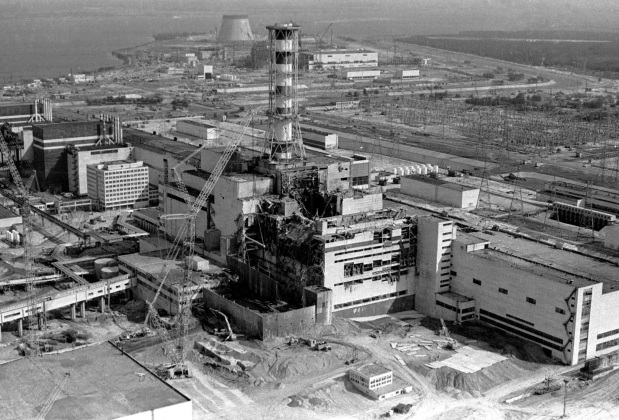
UKRAINE commemorated the 40th anniversary of the Chernobyl disaster yesterday, amid fears that Russia’s four-year war could spark a repeat of the world’s worst nuclear accident that led to thousands of deaths and devastating environmental consequences.
Marking the disaster – which spewed radioactive material across much of Europe as Soviet authorities sought to hide its true scale – has taken on sharp new meaning during Russia’s invasion of its smaller neighbour.
Kyiv says Moscow has repeatedly sent missiles and drones on a flight path near the plant to attack Ukrainian cities, even damaging a critical protective shield in an attack last year.
Russian forces also occupy Ukraine’s Zaporizhzhia Nuclear Power Plant in the southeast, which Kyiv’s state atomic agency said yesterday suffered its 15th temporary blackout since Kremlin troops took over in March 2022.
Yesterday, foreign officials including the EU energy commissioner arrived in Kyiv to commemorate the anniversary and pledge fresh support for Ukraine’s power system, which is regularly targeted by Russian air strikes.
Sombre ceremonies took place in Kyiv and at the Chernobyl plant itself – which was briefly occupied in the first weeks of war – where President Volodymyr Zelenskiy laid a candle alongside the visiting Moldovan president and other officials.
“Right now, the risks are no less great because of what Russia is doing with our Zaporizhzhia Nuclear Power Station, and in general with our energy and our land,” Zelenskiy told reporters in Kyiv.
A Russian drone strike in February 2025 punctured a massive arc installed over part of the Chernobyl plant in 2016 to shield a sarcophagus built in 1986 to cover tons of radioactive debris. No leaks were detected, and workers have patched up the hole.
But the arc needs at least 500 million euros’ worth of more extensive repairs to prevent permanent damage, according to the European Bank for Reconstruction and Development, which is helping raise funds for the project.
Speaking in Kyiv yesterday, International Atomic Energy Agency Director General Rafael Grossi said repairs should start as soon as possible.
&uuid=(email))