

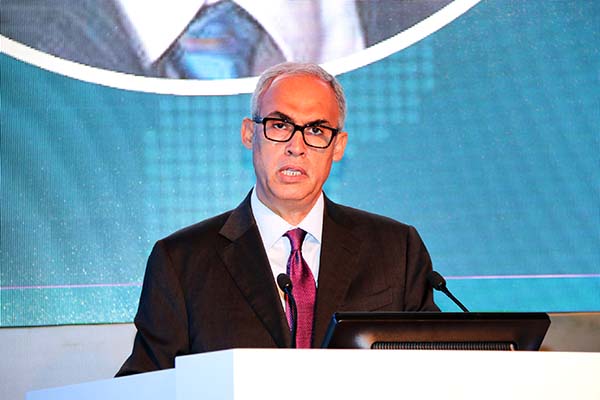
Manama: Central Bank of Bahrain (CBB) Governor Rasheed Al Maraj has made a renewed call to Bahraini Islamic banks to merge or acquire other institutions.
In his keynote address at the opening of the 22nd Annual World Islamic Banking Conference (WIBC), he said given a tougher regulatory environment, challenges to their business model and increased competition from Islamic as well as conventional competitors, the preferred path, particularly for Islamic investment banks, was to merge in order to create institutions of size.
“Not only will this increase their chances of survival by enabling them to participate in larger deals but also help them attract the right human resources,” he said.
“Liquidity management is an important area for Islamic banks.”
Earlier this year, the CBB launched a new Sharia-compliant Wakala liquidity management tool aimed at absorbing excess liquidity of local Islamic retail banks.
“The agreement had been developed based on International Islamic Financial Market’s standard contract.
“The duration of the Wakala is one week, so it is a handy tool for short-term liquidity management of Islamic banks.”
Mr Al Maraj said the CBB is introducing a centralised Sharia Board with a broad mandate.
The board’s scope of work will include overseeing product development by Islamic financial institutions and Islamic windows, strengthening Sharia compliance, providing guidance to the CBB in issuing rules and regulations for the sector, providing guidance to the courts in legal cases involving Islamic financial institutions and acting as the Sharia Board for the CBB, he said.
“It has been given wide authority to determine the direction of product innovation in Bahrain’s Islamic finance sector and to guide the courts in related matters concerning Islamic financial institutions, a unique initiative for any market in the region,” Mr Al Maraj added.
According to him more and stricter regulations, stronger compliance requirements, larger capital commitment and better risk management are part of the new global paradigm after the global financial crisis of 2008.
The CBB has taken several steps to enhance the compliance environment in Bahrain including Sharia compliance.
“Stricter fit and proper criteria for Sharia resources, greater controls regarding the compliance process and clearer divisions between compliance and audit are being introduced,” he said.
Human resource development continues to be an important contributing factor in Islamic finance industry’s growth worldwide.
Mr Al Maraj said a number of training programmes had been launched with Bahrain Institute of Banking and Finance, including Advance Diploma in Islamic Commercial Jurisprudence and Advanced Sharia Reviewer Development Programme, to broaden the horizon of resources and plug knowledge gaps.
“Another landmark initiative of the Waqf Fund that has received industry wide appreciation is the Leadership Grooming Programme aimed at developing the next generation of Islamic banking industry leaders,” he said.
Mr Al Maraj said the decision by the International Monetary Fund to include Islamic finance within its surveillance programme was a welcome development and yet another endorsement of the importance of Islamic finance industry worldwide.
avinash@gdn.com.bh
&uuid=(email))