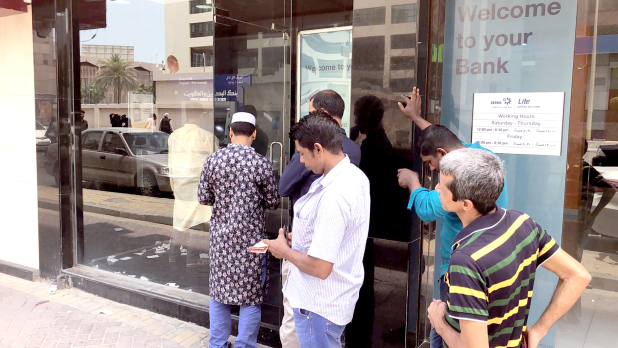
A NEW system in which employers will have to mandatorily transfer salaries directly into staff bank accounts is expected to be rolled out by September.
The scheme was supposed to have been launched last year but was delayed to allow retail banks and payment service providers more time to meet requirements.
The implementation of the Wage Protection System (WPS) has begun with the Central Bank of Bahrain (CBB) working in co-ordination with different banks and the Labour Market Regulatory Authority (LMRA).
“We are now in the administrative phase and expect the WPS to be rolled out by the end of summer,” said LMRA chief executive Ausamah Al Absi.
“The first phase of the scheme will cover all big companies, followed by small companies and then domestic workers in the country.
“This entire process could take over a year until all domestic workers are also covered under the WPS.”
Mr Al Absi explained under the scheme employers will no longer be handing out salaries to their staff in cash.
“It aims to prevent any exploitation and ensure salaries are transferred on time into the bank accounts.”
The GDN reported in January that a document was sent to all banks by Benefit, which handles the country’s electronic funds transfer and ATM transactions, confirming “tentative” plans for WPS implementation in April.
Meanwhile, the CBB in its annual report for 2018 said that banks were gearing up to ensure a smooth adoption of the WPS. “The CBB worked with the First Deputy Prime Minister’s office, the Economic Development Board, the LMRA and the private sector participants to develop a comprehensive legal and technical framework for the implementation of wage protection system (WPS) in Bahrain,” said the report.
“The objective of WPS is to ensure an efficient, fair and timely delivery of salary payments to all Bahraini and non-Bahraini workers in Bahrain.
“During the year (2018) a number of institutions were given approvals to provide WPS.”
Officials have not released 2018 data for non-payment of wages in Bahrain.
However, the GDN previously reported that 1,769 complaints about unpaid wages were handled in 2017.
That compared with 276 cases in 2013, 1,386 in 2014, 1,316 in 2015 and 1,535 in 2016.
According to latest government statistics, Bahrain has a total population of 1,501,611 people with 677,506 (45pc) being Bahrainis and 823,610 (55pc) being non-Bahrainis.
sandy@gdn.com.bh