

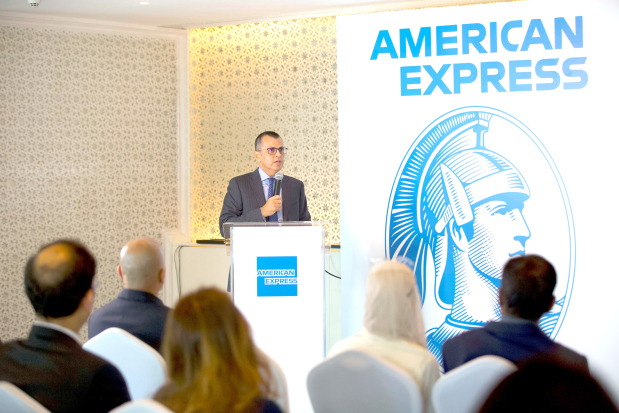
MANAMA: Corporate finance leaders in Bahrain and across the Middle East region remain optimistic for future growth, according to a new American Express global survey.
The 2019 Global Business and Spending Outlook, a survey by American Express Middle East and Institutional Investor Thought Leadership Studio, shows that as many as 67 per cent of respondents from Bahrain and 71pc in the Middle East are expecting substantial or modest expansion in the economy and, despite uncertainty, are upbeat on the outlook for their companies and investments for the future.
The survey also highlights foreign trade driving regional growth prospects; next-generation technology and innovation dominating corporate strategy and spending; the emergence of ‘Generation Z’ as both employees and customers; and the fight for talent extends beyond compensation.
The cross-industry findings in the joint American Express and Institutional Investor study are based on a global survey of 901 CFOs and other senior finance executives of firms with annual revenues of $500 million or more.
About a fifth, 180, of respondents are located across the Middle East region including the UAE, Saudi Arabia, Egypt and Bahrain.
Now in its 12th year, the survey was conducted in late November and December 2018.
While respondents suggest they are less likely to foresee economic growth in the region as they did last year (72pc in 2019 vs 92pc in 2018) due in part to lower oil prices, the growth outlook for the Middle East is in line with expectations worldwide.
The majority saw their companies’ worldwide revenue rise in 2018 and the Middle East showed especially strong firm-level performance compared with Europe and Asia.
“Despite operating in unsettled times, senior finance executives across the region are concentrating on their day-to-day business but keeping an eye on the future,” said American Express Middle East chief executive Mazin Khoury.
“While they balance spending to drive topline growth with profitability, they’re pressing ahead with expansion plans, which include pursuing foreign trade opportunities, hiring and investing in next-generation technology.”
The survey also highlighted that despite uncertainties around global trade issues, a majority (64pc) of respondents in the Middle East expect socio-economic changes and global trade policy would strengthen their companies’ growth prospects in the near future.
This year’s study also revealed growing awareness for the dramatic impact of next-generation technology on competitive dynamics within industries (31pc, up from 23pc last year). Young people under the age of 24 now make up between 50pc and 65pc of the Middle East population, and executives across the region believe their companies are prepared for this generation (Generation Z) and the technological and economic changes they bring with them. Queried on the greatest technology challenge to their industry across the region, senior finance executives in this year’s study cite the use of artificial intelligence (59pc), fintech applications for payments, risk management or investment management (48pc), and the Internet of Things, which includes embedded sensors and ubiquitous, Internet connected devices (43pc).
In the Middle East, 61pc of senior executives expect to increase their companies’ employee numbers between 8pc and 15pc.
However, this increase is not going to be accompanied by aggressive increases in compensation.
Instead companies will focus on improving career development opportunities and working environments.
Just 31pc of respondents intend to raise wages or salaries to attract and retain employees in 2019.
Instead companies will expand career development opportunities (56pc), improve working environments through reconfigured office spaces and increased amenities (56pc), and allow flexible working arrangements (45pc).
avinash@gdn.com.bh
&uuid=(email))