

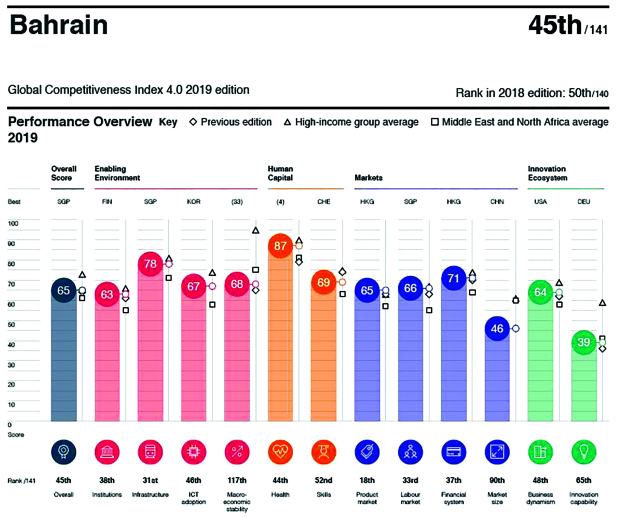
MANAMA: Bahrain has jumped five places to rank 45th in Global Competitiveness Report 2019, published by the World Economic Forum.
The country was ranked 50th last year and has become the fourth most competitive Arab economy, showing an improvement in 65 out of 103 indicators calculated in the report, allowing it to compete with some of the world’s largest and most competitive economies.
A closer look at the indicators shows that Bahrain is ranked first globally in terms of low inflation, second in providing electricity access to the population, fourth in security and also in terms of number of Internet users as percentage of adult population, sixth in government’s long-term vision, seventh in labour market flexibility, eighth in both competition in services and ease of hiring foreign labour and 19th in terms of social capital.
The country is ranked 38th in institutions, 31st in infrastructure, 46th in ICT adoption, 44th in health, 52nd in skills, 18th in product market, 33rd in labour market, 37th in financial system, 48th in business dynamism and 65th in terms of innovation capability.
Overall, the Arab world has caught up significantly on ICT adoption and many countries have built sound infrastructure.
Most of the countries in the region witnessed an improvement except for Oman, Lebanon and Yemen.
However, greater investments in human capital are needed to transform the countries in the region into more innovative and creative economies.
The UAE (25th) leads the regional ranking, followed by Qatar (29th) and Saudi Arabia (36th); Kuwait is the most improved in the region (46th, up eight) while Lebanon, Oman and Yemen lose some ground.
With a score of 84.8 (+1.3), Singapore is the world’s most competitive economy in 2019.
The US remains the most competitive large economy in the world, coming in at second place. Hong Kong (3rd), Netherlands (4th) and Switzerland (5th) round up the top five.
The assessment is based on the Global Competitiveness Index (GCI), which maps the competitiveness landscape of 141 economies through 103 indicators organised into 12 pillars. These pillars are: institutions, infrastructure, ICT adoption, macroeconomic stability, health, skills, product market, labour market, financial system, market size, business dynamism, and innovation capability. For each indicator, the index uses a scale from 0 to 100 and the final score shows how close an economy is to the ideal state or ‘frontier’ of competitiveness.
Building on four decades of experience in benchmarking competitiveness, the GCI 4.0 is a composite indicator that assesses the set of factors that determine an economy’s level of productivity – widely considered as the most important determinant of long-term growth.
“The GCI 4.0 provides a compass for thriving in the new economy where innovation becomes the key factor of competitiveness. The report shows that those countries which integrate into their economic policies an emphasis on infrastructure, skills, research and development and support those left behind are more successful compared to those that focus only on traditional factors of growth,” said WEF founder and executive chairman Klaus Schwab.
This year, the report finds that, as monetary policies begin to run out of steam, it is crucial for economies to boost research and development, enhance the skills base of the current and future workforce, develop new infrastructure and integrate new technologies, among other measures.
The changing geopolitical context and rising trade tensions are fuelling uncertainty and could precipitate a slowdown. However, some of this year’s better performers in the GCI appear to be benefiting from the trade feud through trade diversion, including Singapore (1st) and Vietnam (67th), the most improved country in this year’s index.
“What is of greatest concern today is the reduced ability of governments and central banks to use monetary policy to stimulate economic growth. This makes it all the more important that competitiveness-enhancing policies are adopted that are able to boost productivity, encourage social mobility and reduce income inequality,” said Saadia Zahidi, head of the Centre for the New Economy and Society at the WEF.
avinash@gdn.com.bh
&uuid=(email))