

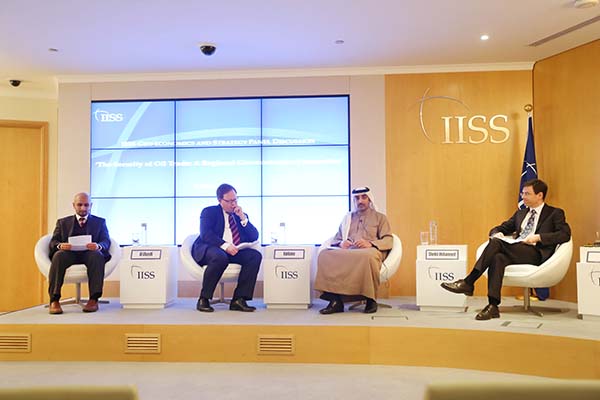
Bahrain: Diversifying regional economies in the wake of slumping oil prices dominated a debate held at the International Institute for Strategic Studies (IISS) yesterday.
National Oil and Gas Authority (Noga) chief executive Shaikh Mohammed bin Khalifa Al Khalifa, who was one of three members on a discussion panel, said the real issue was that government revenue was not diversifying.
The panel, which was debating the security of oil trade, agreed that Strait of Hormuz and Bab-el-Mandeb were unlikely to be significantly threatened in the near future.
“The economy is diversifying, but the government revenue is not,” said Shaikh Mohammed.
“We need trade to survive, so what we need to do is produce some of what we consume.
“We can’t do that with everything, of course, so we need to find a niche, produce that for our own market and then export.
“If we can manufacture some of what we are currently importing, it will help diversify our revenue and ensure our survival.
“Taxation is not the only answer that we have, we need to use a broader set of tools, not just burden the people.”
He added that no one in the GCC region was “comfortable” at the current oil price, even Saudi Arabia.
“Unfortunately, the price of oil today also has no consideration for risk, it has been dismissed by the current market,” said Shaikh Mohammed.
“Bahrain is central for all of this, through our multi-task force that protects the Arabian waters.
“The biggest risk is what would oil prices be at the end of the year – in 2015 they dropped from $100 to $50 a barrel, and in 2016 we saw a further drop to $30 and then we even saw the prices breaking the $20s level.
“No one is comfortable there – you might have Saudi Arabia for instance producing oil at $10 a barrel, but they need far more in order to balance their budget.
“Commodity cannot survive at this level, there will be a shock of supply glut at some point – we just can’t know if it’s going to happen in six months or two years.”
Bahrain Centre for Strategic, International and Energy Studies (Derasat) international and geo-political studies programme director Omar Al Ubaydli added that the balance of power in the region was tenuous.
“Balance of power geopolitically has changed and uncertainty breeds violence,” he said.
“The US doesn’t care as much because it’s importing less oil.
“However, Iran wants to convey an image of being a good neighbour, so it will have a lot to lose if it stirs up trouble in the straits.
“It also wants to attract foreign investment and no one will want to invest if Iran is known to be causing issues in international waters.”
Meanwhile, Economic Development Board chief economist Dr Yarmo Kotilaine spoke of the different factors and challenges involved in the slump in oil prices.
&uuid=(email))