

Bahrain’s success in combating terrorism has been highlighted in an international report by an Australian think tank.
The country’s rank has improved by eight places year-on-year in the Global Terror Index (GTI) 2019, which put Bahrain in 61st position.
That is better than 53rd place last year and marks a significant improvement from 44th place in 2017 and 31st in 2015.
Afghanistan occupies the number one spot in the index, having suffered the worst impact from terrorism.
The release of the report yesterday came just one week after a security official revealed there had been a significant reduction in the number of terrorism cases in Bahrain – dropping from 381 in 2014 to just 52 in 2018.
Bahrain’s overall terrorism score in the index was 3.201 out of 10 (with 10 being the worst).
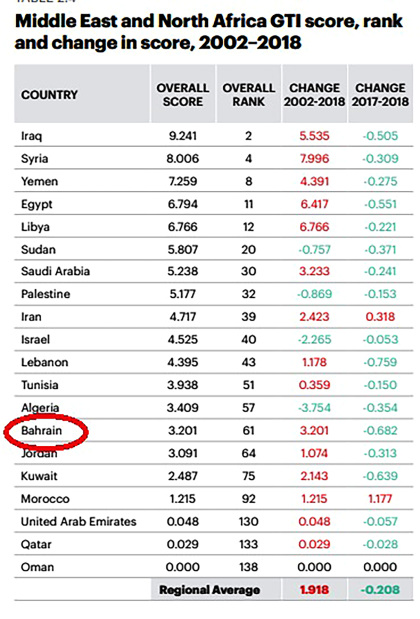
Terrorism rankings in the Mena region
Impact
It previously scored 3.668 in 2017, 4.206 in 2016 and 4.871 in 2015.
The report is compiled by the Sydney-based Institute for Economics and Peace (IEP) and measures the direct and indirect impact of terrorism, including lives lost, injuries, property damage and psychological damage.
Lebanon, Bahrain, Kuwait, Egypt and Iraq were the Middle East countries that saw the biggest improvement in their score, based on 2018 data.
However, Iraq was still ranked second for terrorism globally, followed by Nigeria in third.
Making up the 10 countries in the world most affected by terrorism were Syria (ranked fourth), Pakistan (fifth), Somalia (sixth), India (seventh), Yemen (eighth), the Philippines (ninth) and the Democratic Republic of the Congo (10th).
In the GCC, Oman was the country least affected by terrorism (ranked 138th), ahead of Qatar (133), the UAE (130), Kuwait (75), Bahrain (61) and Saudi Arabia (30).
“Bahrain recorded one attack in 2018, down from 18 in 2017, while Kuwait has not recorded a single terrorist attack in the past two years,” stated the report.
It ranked Afghanistan as the country most affected by terrorism, as it had the largest increase in deaths – up by 59 per cent from the previous year.
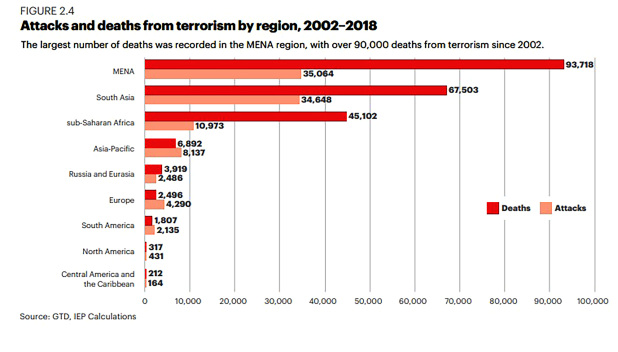
An infographic explains the number of attacks and deaths from terrorism between 2002 and 2018
Conflict
However, the overall number of deaths from terrorism worldwide fell for the fourth consecutive year to 15,952 in 2018, from 33,555 in 2017.
It stated the primary driver of this reduction in the number of deaths from terrorism was a fall in the intensity of conflict in the Middle East and the decline of the Islamic State.
“Preliminary data for 2019 suggests that the decrease in both incidents and deaths from terrorism has continued – and that 2019 will have the lowest level of terrorist activity since 2011,” states the report.
Most deaths from terrorism have occurred in the Middle East and North Africa (Mena) region, which accounts for 93,718 terrorism fatalities since 2002.
In Europe, the number of deaths from terrorism fell for the second successive year, from over 200 in 2017 to 62 in 2018, according to the report.
The global economic impact of terrorism was put at $33 billion in 2018, down by 38pc from the previous year, while in the Mena region that figure was $11.9bn.
IEP executive chairman Steve Killelea said research found that conflict and state-sponsored terror were the key drivers of terrorism.
“In 2018, over 95pc of deaths from terrorism were occurring in countries that were already in conflict,” he said
“When combined with countries with high levels of political terror, the number jumps to over 99pc.”
Mr Killelea explained the collapse of Islamic State in Syria and Iraq was one of the factors allowing Western Europe to record its lowest number of incidents since 2012, with no deaths attributed to the group in 2018.
“However, the situation still remains volatile, with large parts of Syria being contested and many smaller groups sympathetic to IS philosophies being active, leaving the possibility of further Islamist attacks in Europe.”
However, the findings also reveal an increase in female participation in terrorism, although it still accounts for a small percentage of all attacks.
Attacks
This trend has intensified over the past five years, with the number of female suicide attacks increasing by 450pc between 2013 and 2018.
Most of this increase is attributed to Boko Haram, accounting for nearly 80pc of all female suicide attacks in the last five years.
In contrast, male suicide attacks fell by 47pc over the same period.
sandy@gdn.com.bh
&uuid=(email))