

BAHRAIN has registered its fourth Covid-19 death, with 27 new cases recorded yesterday.
The Bahraini man, aged 78, was the first man to die after contracting the virus through contact with an infected person in the country.
The Health Ministry said last night that the man suffered from underlying and chronic health problems.
“The deceased male, who had contracted the virus after being in contact with another active Covid-19 case, was placed in isolation and received extensive 24-hour treatment from a specialised medical team,” said the ministry.
“Excluding one case, all other active Covid-19 cases remain stable and all patients continue to receive treatment from a specialised medical team following guidelines provided by the World Health Organisation (WHO).”
The ministry also expressed its heartfelt condolences to the individual’s family at this difficult time.
This was the second Covid-19 death within 24 hours, after a 65-year-old Bahraini man, who returned from Iran via an indirect flight, died on Tuesday. The other two deaths – two Bahraini women – also contracted the virus while they were in Iran earlier last month. All three had chronic health conditions.
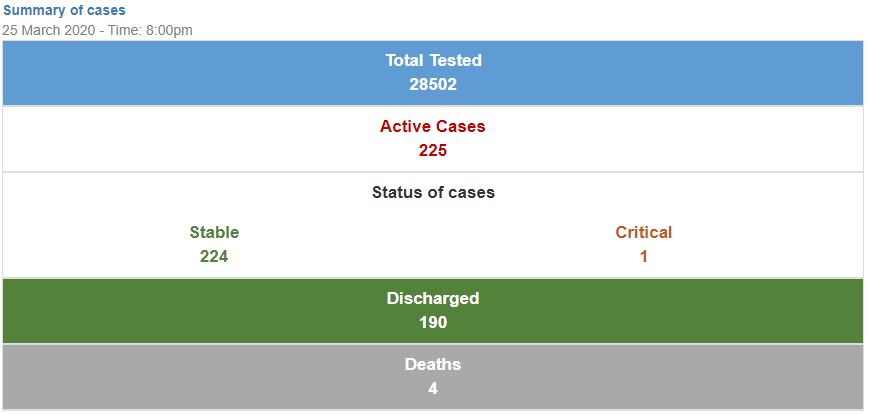
Twenty-seven new cases of Covid-19 were also reported in the country yesterday, bringing the total of active cases to 225.
While another 13 people left treatment and isolation facilities, taking the total number of recoveries to 190, according to the ministry’s website dedicated to Covid-19.
The ministry announced that 43 people left quarantine facilities yesterday, taking the total to 405. These are individuals who completed 14 days under medical monitoring and have been cleared of any infection.
The latest statistics also showed that Covid-19 tests have been conducted on 28,502 people so far in Bahrain.
Meanwhile, Supreme Council for Health chairman Lieutenant General Dr Shaikh Mohammed bin Abdulla Al Khalifa said that Bahrain has increased its capacity to identify and treat Covid-19 cases.
Dr Shaikh Mohammed, who is also the head of the National Task Force for Combating Covid-19, said hospital beds remain available to meet a surge in capacity.
“The current capacity after treatment centres stands at 1,667 beds of which 225 beds are occupied,” he said.
“The capacity for quarantine centres stands at 2,504 beds of which 172 beds are occupied.
“Additionally, the compartmentalised structure of quarantine centres allows for quick conversion to treatment centres if required.
“Bahrain has conducted over 28,000 tests for Covid-19, and contact tracing activities are underway to reduce transmission by identification, isolation and treatment.”
Dr Shaikh Mohammed also lauded the efforts of healthcare workers, adding that it reflects Bahrain’s ability to address the pandemic while preserving the health of citizens and residents.
raji@gdn.com.bh
&uuid=(email))