

RED tide and an increase in pollutants have been blamed for thousands of dead fish washing ashore in Ma’ameer and Eker over the weekend.
Videos circulating on social media showed the small dead fish washing ashore on the coasts of both villages, prompting calls from Parliament for an investigation.
An initial probe has been launched by the Supreme Council for Environment (SCE), which yesterday said its specialists conducted field visits on Thursday and Friday to assess the situation and conducted necessary water quality tests.
It explained that the fish died from red tide, which is a phenomenon caused by algal blooms as they cause depleted oxygen and release toxins into the waters.
“Initial findings indicate that the small fish had died due to red tide with the water colour turning red or green/brown,” said the SCE in a statement.
“The red tide is a culmination of multiple factors like the Tubli Wastewater Treatment Plant processing more than its capacity, high temperature, shallow waters, and slow current in Tubli Bay.
“The same applies to the Ma’ameer water channel that has mud clustered there for over two decades leading to it also becoming shallow, while its northern and southern exit spaces are narrow and this causes water to be stagnant.
“Algae feeds on oxygen during red tide and when fish pass by they suffocate.”
The SCE also found an increase in pollutants like ammonia and faecal bacteria, which it attributed to sewage dumping.
“An increase in pollutants has been found and this puts pressure on the environment and kills fish,” added the statement.
“The dead fish are being removed by the relevant authorities to ensure foul smell and illnesses do not spread.”
Parliament’s public utilities and environment affairs committee vice-chairman Ahmed Al Demistani also told the GDN yesterday that officials from the SCE, the Works, Municipalities Affairs and Urban Planning Ministry, and the Health Ministry will be summoned this week to discuss the initial findings.
Findings
This is not the first time that dead fish has washed ashore on Bahrain’s coasts, with around 50kg of dead fish found on Ma’ameer coast in October last year and in August last year.
The August incident was days after a similar occurrence in the nearby Tubli Bay in July last year.
“This is a reoccurring incident and every time the response is that it is natural occurrence due to soaring temperatures and other environmental aspects,” said Mr Al Demistani.
“We need convincing transparent answers because if it is a natural matter then it would happen in nearby coasts as well as in Sitra, Askar, Mina Salman and Hidd. So, why is it only Ma’ameer and Eker? The two areas that are highly populated with industries.”
Area MP Ammar Al Mukhtar claimed the source of the pollutants was from the Tubli Wastewater Treatment Plant, an allegation that surfaces every time dead fish wash ashore.
According to statistics from the World Population Review 2018, Bahrain is among the top most polluted countries in the world, ranking at number six out of 92 nations.
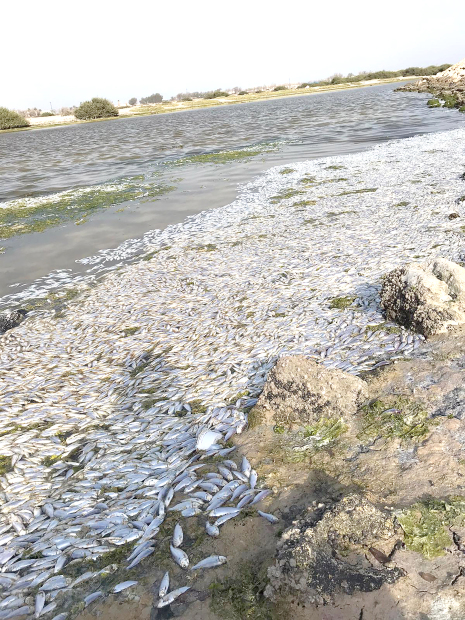
Thousands of dead fish on the shore. Inset, cleaners removing dead fish
“We are in a period of transparency and there is nothing to hide or be afraid of, so why not have the United Nations Environment Programme conduct a scientific investigation in the area,” he said.
“Clearly the Tubli Wastewater Treatment Plant is the main source as all of the areas around it have seen death in fish and the issue is not soaring temperatures or any other reason.”
However, environmentalist Hassan Al Moghni said simply blaming one factor was not productive as comprehensive long-term tests were needed.
An environmental specialist at the SCE told the GDN in August last year that the release of sewage water from the Tubli sewage plant, which is not fully treated, into the coast could be a major reason that led to the deaths of the fish along with the concern of water circulation being limited in the Ma’ameer coast.
mohammed@gdn.com.bh
&uuid=(email))