

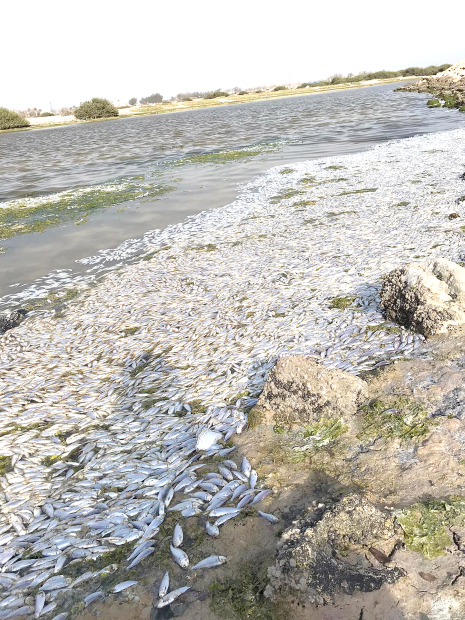
MPs have demanded real action after an environmental assessment of Ma’ameer and the surrounding areas was ordered by His Royal Highness Prime Minister Prince Khalifa bin Salman Al Khalifa.
The study, ordered during the Cabinet session held remotely yesterday, will also focus on air quality and emissions by factories and industrial establishments.
It is also expected to come up with solutions to limit pollution threatening the health and safety of citizens and residents.
The Premier also demanded that work be speeded up on widening the Ma’ameer water channel to allow better circulation in Tubli Bay.
The Works, Municipalities Affairs and Urban Planning Ministry and the Oil Ministry have been handed the task.
The order follows an investigation in April launched after videos circulating on social media showed thousands of dead fish washed ashore in Ma’ameer and Eker villages.
Initial findings had blamed red tide and an increase in pollutants in the water for the incident.
Red tide is a phenomenon caused by algae blooms which deplete oxygen and release toxins in the water.
As part of the probe, experts from the Supreme Council for Environment (SCE) conducted field visits to assess the situation, as well as necessary water quality tests.
The SCE also found an increase in pollutants like ammonia and faecal bacteria – attributed to sewage dumping.
This was not the first time that dead fish had washed ashore; around 50kg of dead fish were found on Ma’ameer coast in August and October last year.
The August incident was days after a similar occurrence in the nearby Tubli Bay the previous month.
“The Premier’s order follows repeated incidents in the area in which fish have died in large numbers with there being no proper solution other than clearing the dead fish,” said area MP Ammar Al Mukhtar.
“The initial findings of the probe were announced in April and ministries and government bodies concerned should have sprung into action, but they did nothing,” he added.
“We appreciate the concern shown by the Premier, and hope the two ministries will come up with a solution.”
The SCE said the red tide was caused by a number of factors like the Tubli Wastewater Treatment Plant processing more than its capacity, high temperature, shallow waters, and slow current in Tubli Bay.
It added that the same applied to the Ma’ameer water channel where accumulated mud had made it shallow and the exits narrow causing water to become stagnant.
“This is a recurring phenomenon, and each time the response is that it is a natural occurrence due to soaring temperatures and other environmental aspects,” said Parliament public utilities and environment affairs committee vice-chairman Ahmed Al Demistani.
“Nature doesn’t destroy itself; there are factors that need to be tackled and resolved,” he added.
“The SCE pointed to the source of the problem, but no proper solutions were found; the delay could result in a repeat of the problems as we approach July and August.”
According to the World Population Review 2018, Bahrain is among the most polluted countries in the world, ranking at number six out of 92 nations.
An environmental specialist at the SCE told the GDN in August last year that the release of partially treated sewage water from the Tubli sewage plant into the coast could be a major reason for the deaths of the fish along with the concern of water circulation being limited in the Ma’ameer coast.
mohammed@gdn.com.bh
&uuid=(email))