

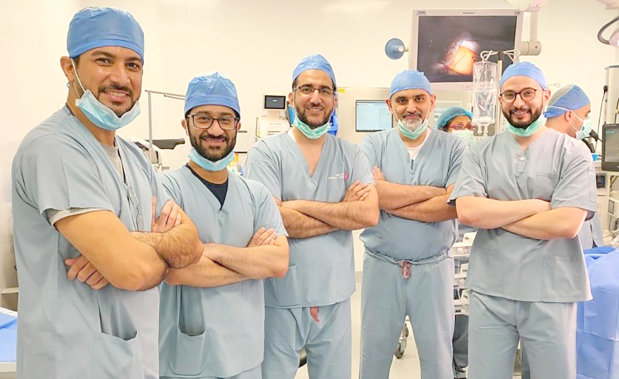
Medics in Bahrain have carried out pioneering surgery, usually performed at specialist hospitals abroad, to help save the life of a cancer patient.
They successfully removed a maligant tumour from a 59-year-old Bahraini’s lower oesophagus during a delicate four-hour operation at King Hamad University Hospital (KHUH).
The man had sought medical help after suffering difficulty swallowing and stomach pain, in addition to a loss of appetite and weight, often symptoms of oesophageal cancer. The esophagus, sometimes called the gullet or food pipe, helps move food swallowed from the back of the throat to the stomach.
After performing a clinical examination and carrying out further tests and X-rays, a biopsy was taken and the malignant tumour was discovered.
The KHUH medical team said that the patient was set to have the procedure carried out overseas. However, due to Covid-19 travel restrictions, it was decided to operate without further delay in Bahrain.
The operation was carried out by a highly qualified surgical team under the supervision of chest surgery consultant Ghassan Al Faqawi and general surgery and endoscopic and oncological surgery consultant Dr Hani Al Sa’ati, with the participation of Dr Abdulaziz Al Mutawa, Dr Ahmed Al Otaibi and Dr Basil Ibrahim.
“After the diagnosis of the case, it was discussed and the appropriate treatment plan was immediately established at the National Oncology Centre. It was decided to treat the patient in two phases, the first being surgery,” said a spokesman for the medical team.
“Modern technology was used to perform a very accurate hospital procedure. It took four hours under total anaesthesia to completely remove the tumour from the bottom of the oesophagus. The operation was successful, thanks to the grace of God.
“The patient was supposed to receive his treatment outside the Kingdom of Bahrain, but due to the Covid-19 health crisis that the world is going through, and the travel ban precautions introduced, the medical team at King Hamad University Hospital has ensured the treatment of this condition, using the advanced equipment it owns, in addition to the availability of qualified medical cadres.”
The patient has left the hospital and is said to be in the ‘best condition possible’ to proceed with the second stage of treatment, which is radiation therapy at the National Oncology Centre.
Recent studies suggest around 55 per cent of patients with oesophageal cancer will survive for five years or more when they are diagnosed at the earliest stage and undergo individual combination treatment plans.
&uuid=(email))