

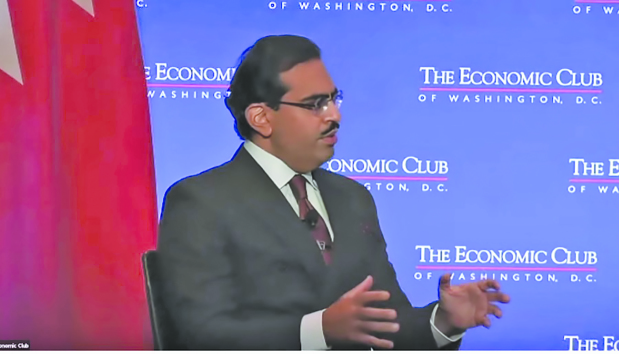
MANAMA: Bahrain and other Gulf countries should be consulted by the newly-elected US administration before any new nuclear programme agreement is tabled and agreed with Iran, a top envoy believes.
Bahrain Ambassador to the US and non-resident Ambassador to Canada Shaikh Abdulla bin Rashid Al Khalifa is determined that Iran’s policies and ambitions be highlighted by US allies in the region.
“I think countries around the world need to realise the effects of Iran’s policies not only in the region but the entire world,” stated Shaikh Abdulla.
“When you have an attack on the global energy infrastructure, a guy in California filling up his gas tank is going to realise there is a difference in what he is paying.”
The Bahraini diplomat was among top-level speakers, along with his UAE and Israeli counterparts, at a forum organised by The Economic Club of Washington DC.
During the discussion, Shaikh Abdulla spoke about the challenges the region faces because of Iran which should be considered by the US government moving forward.
President-elect Joe Biden is set to take office on January 20 and has already suggested that he will return the US to the nuclear deal, if Iran resumes compliance to the conditions laid down.
Iran has recently breached restrictions imposed by the 2015 deal on its atomic activities, including on the purity to which it enriches uranium and its stock of enriched uranium.
These breaches came in response to US President Donald Trump’s withdrawal from the nuclear deal in 2018 and the re-imposition of sanctions against Tehran that had been lifted under the accord.
“I think it’s important for the US government going forward if we were to see an agreement with Iran to take into consideration all the challenges that we are facing in the region,” said Shaikh Abdulla.
“And, we are talking not just the ballistic missile programme, but we are talking about proxy activities, the spread of ideology of this hegemony ambition that we have seen from Iran for 40 years now.
“I think as allies to the US we stand ready to be at the table talking about what is important to us and assisting in any way possible going forward.”
The signature event marked the first time that the ambassadors from the three countries had shared the same stage to discuss the opportunities, challenges, and the way forward to meaningful changes in the region following the signing of the Abraham Accords in September.
Shaikh Abdulla, during the discussion, added there had been a positive feedback to the peace agreement and said that Bahrain had consulted its allies and neighbours in the region ahead of the accord signing. “In any democratic society there will be those with the decision and those against, but we had overwhelming support,” added the diplomat.
“People in Bahrain are looking at it positively and the positive implications out of this deal.”
He told delegates that the only synagogue in the Gulf is in Manama, while hotels were working on kosher meals anticipating visits from tourists and business people as a result of the historical deal.
Shaikh Abdulla further added the peace deal should unlock business opportunities that would help entrepreneurs.“We have always been looking at peace within the region as a pillar of economic stability to move forward,” he said.
The GDN reported yesterday that leaders from Bahrain, the UAE and Jordan during a tripartite summit in Abu Dhabi discussed the need to achieve a just and comprehensive peace on the basis of the two-state solution with Jerusalem as its capital.
Bahrain and Israel agreed to start operating commercial flights and initiate procedures to open embassies based on agreements signed in Tel Aviv. Foreign Minister Dr Abdullatif Al Zayani headed a Bahrain delegation to Tel Aviv and held talks with Israeli Prime Minister Benajmin Netanyahu and US Secretary of State Mike Pompeo.
&uuid=(email))