

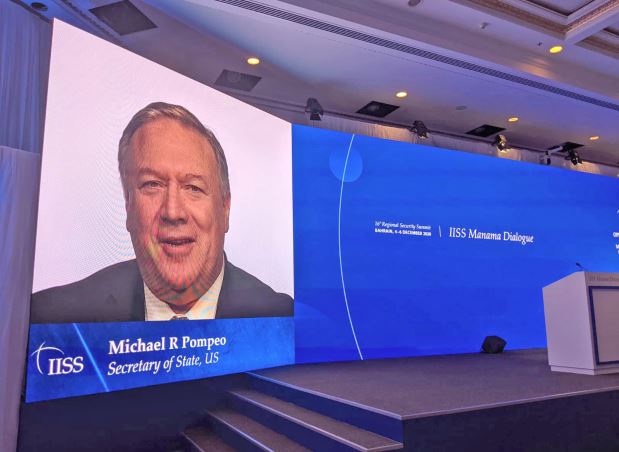
SANCTIONS on Iran have deprived the regime of $70 billion that would have been spent on terror, said US Secretary of State Michael Pompeo last night.
The senior US diplomat added that Tehran’s “anti-semitic government” was “desperately” trying to negotiate on sanctions relief, adding that Iran’s proxies like Hizbollah have been left in a deep “austerity mode”.
Challenges
Mr Pompeo was speaking virtually at the opening of the 16th International Institute for Strategic Studies (IISS) Regional Security Summit: The Manama Dialogue 2020.
The forum continues until tomorrow at The Ritz-Carlton Bahrain.
Due to the coronavirus (Covid-19) pandemic, this year’s annual conference is being held in a hybrid format with some participants physically attending the meeting, while others will be tuned in virtually.
Mr Pompeo warned that the challenges of Iran’s nuclear programme “still remain in front of us”.
In his debut address at the annual summit, he touched upon a number of issues including US President Donald Trump administration’s approach to foreign policy and its achievements with partners in the Middle East.
“Our signature successes in the Middle East demonstrate what happens when we get things right.
“The Trump administration is trying to get that balance just right,” he said, citing that exactly four years ago the administration “saw the true cause of conflict in the Middle East”.
“It was not the Israel-Palestinian conflict, but the Islamic State and the leadership in the Islamic Republic of Iran, the world’s largest state sponsor of terror.
“We started our project in the Middle East by leading the fight against ISIS, we had 82 partners, and eliminated the caliphate in relatively short order.
“This was a remarkable, multilateral victory that deserves more attention.
“We did this well, we did this right and the world remains safer today, as a result of that enormously good collective effort.”
Mr Pompeo highlighted the US did away with the Joint Comprehensive Plan of Action (JCPOA) because it helped Iran fund terrorism.
Iran signed the JCPOA with the permanent members of the UN Security Council – the US, Britain, France, Russia and China – as well as Germany in 2015.
Based on it, Iran agreed to restrict certain aspects of its nuclear energy activities in return for the removal of nuclear-related sanctions against the country.
In May, Trump pulled Washington out of the JCPOA despite objections from other parties.
“We got out of the JCPOA away, which traded cash and immunity for Tehran’s malign behaviour in exchange for unverifiable nuclear pledges that put us all at risk,” said Mr Pompeo.
“On Iran, we simply saw the regime for what it is, an anti-semitic government that terrorises its neighbours and its own people.
“We learned the lessons from the prior administration’s appeasement, that sending pellets of cash didn’t change Iran’s behaviour, rather it funded and supercharged their terror campaigns.
“The regime’s behaviour must change,” which he said included the small, external activities that they get engaged in.
He also added that Israel should be a partner “not a problem” for countries in the region.
This, he said, led to the US taking a different approach, rejecting appeasement and putting security and deterrence in the front.
“Not dialogue for dialogue’s sake, (but) at the very front a realistic approach.
“With the help of our Gulf allies, our maximum pressure campaign isolated Iran diplomatically, militarily and economically.”
Mr Pompeo noted there were about 77 rounds of sanctions on Iran targeting close to 1,500 individuals and entities.
“We have deprived the regime, according to their own words, of some $70bn for terror.
“We know too that our campaign is working because now the Iranians are desperately signalling their willingness to return to the negotiating table to get sanctions relief.
“This effort in the Middle East isn’t just about counting Iran as vital as that is.
“American strength and resolve have given the leaders in the region the space and importantly the confidence to pursue peace and prosperity,” citing the signing of the Abraham Accords at the White House in September.
“This would not have been possible without the maximum pressure campaign and our active diplomacy with strong partners in the region.
“We’re not done, (will) continue to build on that progress – goods and people are now criss-crossing the region along entirely new routes.”
Ahead of the opening, IISS director and chief executive John Chipman highlighted nationalistic tendencies that have “emerged in response to Covid-19”, noting that “tending to the legal structure of international society is important”.
raji@gdn.com.bh
&uuid=(email))