

Global shares rose yesterday after losing ground in the prior session amid renewed focus on the economic impact of artificial intelligence and with markets still grappling with the implications of US President Donald Trump’s tariff policies.
San Francisco-based startup Anthropic unveiled 10 new ways for business customers to use its AI plugins, including in investment banking, human resources and engineering, just weeks after other releases sparked a feverish selloff in software and services stocks. Uncertainty from Trump tariffs persisted in markets after the US Supreme Court ruled his emergency tariffs were unlawful on Friday.
The US Customs and Border Protection imposed a new tariff from yesterday of 10 per cent on all goods not covered by exemptions, the rate first announced by Trump on Friday rather than the 15pc he promised a day later.
Wall Street stocks were higher after losing ground in early trade. The Dow Jones Industrial Average rose 0.83pc, the S&P 500 rose 0.60pc, and the Nasdaq Composite rose 0.91pc.
The uncertainty and back-and-forth from tariffs is starting to take a back seat and the market is trying to understand the implications of AI for company earnings, said Ken Mahoney, president and chief executive officer at Mahoney Asset Management in New Jersey.
“We’ve already established that we’re going to lose jobs with AI and AI may in fact do things better and more efficiently than some of the older software programmes out there but then you start calculating that if these companies are going to let a lot of people go because of AI that means fewer licences from the likes of Microsoft,” Mahoney said.
“We went through all these areas and all that negativity and it’s nice to see it bouncing back to about half of where we were yesterday,” he said. European stocks rose 0.35pc. Britain’s FTSE edged higher by 0.09pc.
MSCI’s All-World index was up 0.34pc after dropping 0.62pc. Shares of International Business Machines plunged by more than 13pc – their biggest one-day fall since late 2000 – after Anthropic said its Claude Code tool could be used to modernise a programming language run on the company’s systems. IBM stock recovered and was last up 4.7pc.
The sheer scale of corporate borrowing and spending on AI has been enough to make many nervous, not least because of the outsized market weight of companies at the heart of the boom. AI chipmaker Nvidia, which reports earnings after the bell today, accounts for around 8pc of the entire S&P 500. Nvidia was up 0.5pc.
“The biggest concern is margins. And margins, seemingly with new and cheaper technology, is something that’s really bothersome to markets,” Mahoney said. The yield on benchmark US 10-year notes rose 0.4 basis points to 4.031pc. The 2-year note yield, which typically moves in step with interest rate expectations for the Federal Reserve, rose 2.1 basis points to 3.461pc.
In currencies, the yen weakened following a report that said Japanese Prime Minister Sanae Takaichi had conveyed her reservations about further interest rate hikes to Bank of Japan Governor Kazuo Ueda. The Japanese yen weakened 0.72pc against the greenback to 155.75 per dollar.
The dollar weakened 0.15pc against the Swiss franc at 0.7737. The euro was flat at $1.178625 against the dollar. Sterling strengthened 0.23pc to $1.352.
Brent crude traded down 0.62pc at $71.03 per barrel, while tensions continued to simmer between the US and Iran. Safe-haven gold dropped 1.56pc at $5,150 an ounce.
Meanwhile, Gulf markets reversed early trends by the closing bell yesterday, as investors adopted a cautious stance in a volatile session ahead of a third round of US-Iran nuclear talks scheduled for tomorrow.
Saudi Arabia’s benchmark stock index retreated 0.7pc after a modest recovery in the prior session, as the kingdom’s budget deficit widened quarter-on-quarter due to higher expenditures.
Losses were broad-based, with Saudi Telecom Company down 2.1pc and Saudi Aramco shedding 0.5pc. Reuters reported, citing trade sources, that energy giant Aramco has sold several shipments of ultra-light crude oil from its $100 billion Jafurah gas plant to U.S. majors and an Indian refiner, ahead of its first export later this month. The market is well-positioned to build on its strong fundamentals as external pressures ease, said Antoine Nadaf, country manager at Givtrade.
In Dubai, the main stock index declined 0.6pc, following a nearly 2pc surge in the prior session. Weighed down by banking stocks, Emirates NBD Bank saw its sharpest one-day drop in nearly three months, tumbling over 4pc, while Dubai Islamic Bank retreated 1.6pc.
Abu Dhabi’s stock index ended flat, holding its ground after rebounding in the prior session from a two-day sell-off at record highs. ADNOC Gas edged down 0.3pc, while Abu Dhabi Commercial Bank gained 0.3pc, continuing Monday’s advance.
Nadaf noted that Abu Dhabi market retains upside potential, backed by robust fourth-quarter results and solid economic projections, though oil price volatility remains a key watchpoint.
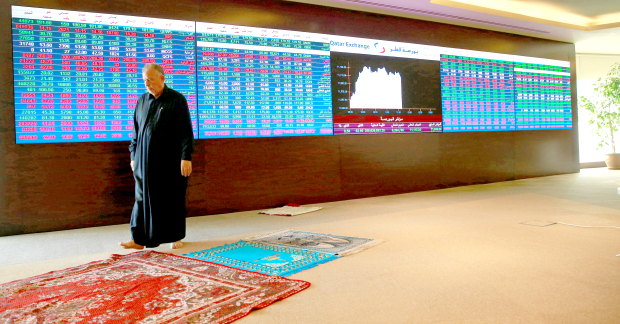
Qatar’s stock index added 0.1pc, driven by banking shares. Qatar National Bank, the region’s largest lender, gained 0.5pc, extending momentum from its best daily performance since mid-October in the previous session.
US-based private credit investment firm 5C Investment Partners announced a strategic partnership with the Qatar Investment Authority to expand its direct lending platform.
Outside the Gulf, Egypt’s blue-chip index slipped 0.9pc with a sell-off led by banking stocks. Commercial International Bank, the country’s largest private lender, fell 1.3pc. Talaat Moustafa Group declined 1.6pc, reversing gains from the previous session, after the real estate developer reported a 43pc rise in full-year profits on Monday and secured a promotion to the mid cap segment of the FTSE Russell Global Equity Index Series.
&uuid=(email))