

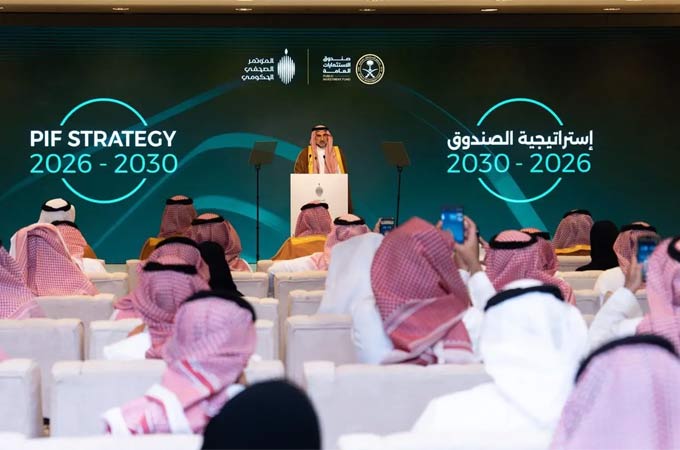
Saudi Arabia's Public Investment Fund (PIF) has approved its 2026-2030 strategy which focuses on transforming PIF’s portfolio of 13 strategic sectors into six integrated economic ecosystems, strengthening the linkages among them and creating a broader spectrum of partnership and investment opportunities for the private sector.
The new strategy was approved by the PIF Board of Directors, chaired by His Royal Highness Prince Mohammed bin Salman bin Abdulaziz Al Saud, Crown Prince and Prime Minister, on Wednesday.
By sharpening financial returns, the strategy deepens PIF’s contribution to the Kingdom’s long‑term prosperity, said PIF Governor Yasir Al-Rumayyan, who reviewed the progress and achievements of the fund.
Addressing a press conference, Al-Rumayyan emphasised that the new strategy builds on PIF’s pivotal role in leading the Kingdom’s development and economic diversification agenda, directly supporting the objectives of Saudi Vision 2030 to create a vibrant, sustainable economy and safeguard the nation’s wealth for future generations.
He noted that the Kingdom’s sound fiscal position, strategic geographic advantage, advanced infrastructure, and globally connected liquidity provide a strong platform to attract diversified capital.
Three distinct portfolios
The PIF will structure its investments into three distinct portfolios, each with distinct strategic objectives that support the delivery of PIF’s mandate. First, the “Vision Portfolio,” is intended to deepen integration among the Kingdom’s priority strategic sectors, maximise the value of PIF’s portfolio companies and sustain the growth of the domestic economy. By developing six fully integrated economic ecosystems, the Vision Portfolio enhances the synergy of PIF’s investments, raises their competitiveness and creates broader opportunities for partnership with the local private sector—as investor, partner and supplier—while also attracting international partners and investors.
Second, the “Strategic Portfolio,” which focuses on managing and optimising returns from strategic assets, amplifying the economic impact of PIF’s companies and supporting their efforts to draw both domestic and foreign capital and to evolve into global leaders. Through this portfolio PIF will continue to invest in long‑term, high‑impact sectors that reflect macro‑economic dynamics and global trends.
Third, the “Financial Portfolio,” aims to generate sustainable financial returns that reinforce PIF’s balance sheet and its role in growing national wealth for future generations. It concentrates on PIF’s direct and indirect investments in global markets, with the objective of maximizing yields, further diversifying and strengthening the portfolio’s resilience, and building strategic alliances that unlock additional international capital and investment opportunities.
Tourism and entertainment
The governor addressed the Tourism, Travel, and Entertainment ecosystem, which aims to capitalise on the growing Saudi tourism industry by developing strategic assets that generate reliable returns, improving air‑connectivity and leveraging world‑class events to attract visitors. It will support the creation of more than 100,000 hotel rooms, introduce over 70 new tourism experiences, deliver three stadiums ready to host the 2034 FIFA World Cup and expand King Salman International Airport’s capacity to accommodate 96 million passengers — aligned with the Kingdom’s goal of welcoming 150 million tourists annually by 2030.
The ecosystem includes flagship entities such as Red Sea International, Qiddiya, Savvy Group for e‑sports, SURJ Sports Investment, Expo 2030 Riyadh, King Salman International Airport, and Riyadh Air.
Urban development
He said the Urban Development and Livability ecosystem focuses on opportunities around Saudi Arabia’s flourishing urban development, while supporting efforts to improve quality of life and increase home ownership. It underpins several national targets, notably raising Saudi home‑ownership to 70 % through the construction of up to 190,000 housing units by 2030 and adding approximately 5 million sqm of commercial space. Key participants in this ecosystem include Roshn Group, New Murabba, Jeddah downtown, and KAFD.
Advanced manufacturing
Al-Rumayyan highlighted the Advanced Manufacturing and Innovation ecosystem, which aims to build new export-oriented sectors that will anchor the Saudi economy of the future through the development of integrated industrial clusters in artificial intelligence, automotive, pharmaceuticals, and aviation, space and defense, amongst others. It will raise the nation’s manufacturing capabilities, create high‑value export‑ready products, boost productivity and generate quality jobs. Key targets include expanding data‑center capacity to 3,000 MW (PIF is committing 1,800 MW), contributing up to SAR7 billion to domestic pharmaceutical manufacturing, and producing 285,000 vehicles toward the national goal of 500,000 units by 2030. Representative companies are HUMAIN (AI solutions), CEER (electric vehicles), Nupco (medical supplies and pharma) and SAMI (military industries).
Industrials and logistics
He also highlighted the Industrials and Logistics ecosystem, which supports the development of the Kingdom’s core infrastructure, strengthening logistics networks, basic industries and mining output, with PIF improving logistics‑infrastructure quality to raise Saudi Arabia’s Logistics Performance Index and meet container‑throughput targets. At the same time, mining production will be expanded to raise the sector’s contribution to GDP. The ecosystem’s principal assets include Ma’aden, Saudi Iron & Steel (Hadeed) and Bahri.
Clean energy
In the Clean Energy, Water, and Renewables Infrastructure ecosystem, Al-Rumayyan underscored cementing Saudi Arabia’s position as a global energy leader and a benchmark for sustainable power. Its primary purpose is to accelerate the development of renewable‑energy sources and diversify the Kingdom’s energy export portfolio. The ecosystem aims to raise renewable‑energy generation capacity to 100 GW, with PIF targeting 44.5 GW in total. Key partners include ACWA, Saudi Electricity Company, Marafiq, Energy Efficiency & Conservation Company (Tarshid), and SIRC Recycling.
$200bn invested in five years
Al-Rumayyan revealed that between 2021 and 2025, the PIF deployed approximately SAR750 billion ($199.92 billion) in new domestic projects, representing around 70% of its total investments, while consistently securing an annual average total portfolio return exceeding 7% since 2017.
With the launch of Saudi Vision 2030, PIF accelerated its role as a driver of economic transformation, launching transformative giga-projects such as NEOM, the Red Sea Project, Qiddiya, and Roshn.
In parallel, Al-Rumayyan stated that PIF introduced the Future Investment Initiative (FII), which has grown into one of the world’s leading investment platforms. Since its inception, FII has convened thousands of global leaders and investors, facilitating deals worth $250 billion, and expanded its international footprint with summits in major markets including London, Miami, Tokyo, and Hong Kong.
Furthermore, PIF has opened subsidiary offices in key regions across Asia, Europe, and the United States, complemented by regional hubs in Egypt, Bahrain, Jordan, and Oman, to identify suitable opportunities and assist both PIF portfolio companies and private‑sector partners in expanding into these markets.
Highlighting the 2021-2025 strategic phase, Al-Rumayyan detailed PIF's success in growing its asset base and investing in 13 strategic sectors. These investments have directly improved the quality of life for citizens, with national champions like Roshn supporting the goal of increasing homeownership. In the gaming and esports sector, Savvy Games Group hosted the Esports World Cup in Saudi Arabia, attracting over 3,500 professional players. Advancing the artificial intelligence sector, PIF launched HUMAIN, a company dedicated to developing AI solutions and advanced technologies, further positioning the Kingdom as a global hub for data and AI capabilities.
Key investments
He further elaborated on PIF’s role in unlocking the potential of leading Saudi companies. Through its investment in ACWA Power, PIF is developing 70% of Saudi Arabia’s renewable energy target for 2030.
Investments in Bahri transformed the company into a global leader with a fleet of over 100 advanced vessels, while strategic support for Ma’aden boosted its global standing and increased its market value from SAR60 billion to SAR247 billion by the end of 2025. Between 2021 and 2024, PIF contributed roughly one-third of the Kingdom’s non-oil real GDP growth, delivering SAR910 billion in cumulative impact.
Investments in non‑oil sectors, particularly tourism, have enabled the development of more than 3,600 hotel rooms and the operation of 19 international hotels across the Red Sea, Qiddiya, AlUla and Diriyah projects. Local content spending reached SAR207 billion in 2024 alone, representing 44% of the Kingdom’s non-oil revenue. The proportion of local content also rose, moving from 46 % in 2020 to 57 % by the end of 2024 across PIF and its portfolio.
From 2021 through to Q3 2025, the PIF’s companies attracted approximately SAR57 billion in direct foreign investment in a range of emerging and new sectors, including real estate, automotive, transportation and logistics, and telecommunications and technology. He added that strategic partnerships with leading global asset managers have enabled those managers to expand their operations and establish regional offices in Saudi Arabia. Between 2021 and 2025, these collaborations brought more than SAR75 billion of foreign capital into the Saudi market, deepening the Saudi financial market, fostering the development of local talent, launching innovative investment products, and nurturing domestic asset‑management capabilities.
Real estate investments
In the real estate sector, PIF generated 12,000 private-sector opportunities valued at SAR562 billion.
Supporting SMEs, PIF’s subsidiary Jada allocated SAR3.5 billion across 46 venture capital and private equity funds, while Sanabil Investment committed roughly SAR1.5 billion to support 165 emerging companies. Al-Rumayyan highlighted that PIF’s robust financial position is reflected in its top-tier ratings from global agencies—Moody’s (Aa3), Fitch (A+), and S&P (A-1). Assets under management have surged almost six-fold since 2015, exceeding SAR3.4 trillion by the end of 2025.
&uuid=(email))