

Bahrain’s noble stance to push for a two-state solution to end the Israeli-Palestinian conflict will lay the foundations for regional peace and security, said a visiting senior British minister yesterday.
Minister of State for the Armed Forces in the UK Leo Docherty praised the “deep and historical ties” with Bahrain as the two nations work together in defence and other areas.
In a wide-ranging exclusive interview at the British Embassy, Mr Docherty spoke about the ongoing Gaza conflict, its spillover to other countries including the UK, threats posed by Iranian proxies, Houthi attacks in the Red Sea and other regional issues.
“We want to work with our allies to bring peace and stability to the region,” he said.
“We live in a world that is the most turbulent it has been in a very long time.
“We have a land war in Europe, conflicts in the Middle East, regional tension in the Red Sea and around the Gulf and we have the rise of assertive China.”
Mr Docherty’s visit comes ahead of the 33rd Arab Summit which is being held on Thursday under the presidency of His Majesty King Hamad.

Mr Docherty
Mr Docherty yesterday met Foreign Minister Dr Abdullatif Al Zayani and said the Arab Summit was an important gathering to discuss regional challenges and security issues.
Speaking about the spillover of the Gaza conflict, he referred to student protests at prestigious universities in the UK and US.
“It’s a very emotive subject for reasons we all understand and our policy is to ensure that civilian lives are protected and humanitarian aid can be delivered.
“Fundamentally, we believe in a just two-state solution for the Palestinian people, which is at the heart of this problem,” said Mr Docherty.
“And we commend the approach taken by Bahrain and other regional players for ensuring that this is on the agenda.
“So, I think what we hope for is that we can achieve a de-escalation and we make the point that civilian lives must be protected.”
The UK began conducting airdrops in March along the northern coastline of Gaza as part of the Jordanian international initiative.
The Royal Air Force completed its 11th airdrop last Thursday, delivering a total of 110 tonnes of aid via 120 parachutes, comprising ready-to-eat meals, water, rice, tinned food and flour.
The Gaza conflict was triggered by a Hamas-led attack on southern Israel on October 7 in which some 1,200 people were killed and more than 250 people taken hostage, according to Israeli tallies.
Israel’s military operation in retaliation has killed close to 35,000 Palestinians, according to Gaza’s health ministry.
The constant bombardment has laid waste to the coastal enclave and caused a deep humanitarian crisis.
Royal Navy support ship RFA Cardigan Bay recently set sail from Cyprus to support international efforts to open a maritime aid corridor to Gaza.
The ship is providing accommodation for hundreds of US sailors and soldiers building a temporary pier off the coast of Gaza.
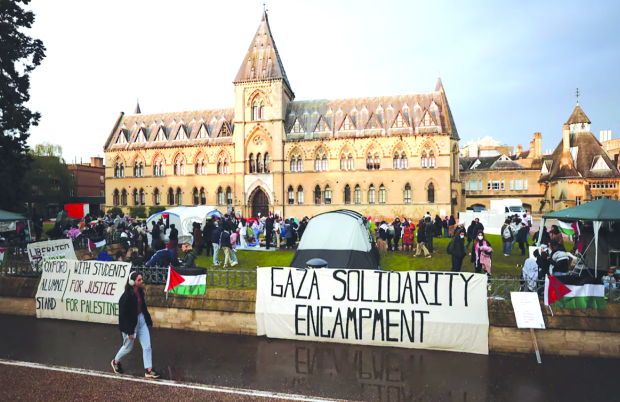
A woman walks near tents at Oxford University, outside Oxford University Museum of Natural History, as students occupy parts of British university campuses to protest in support of Palestinians in Gaza
According to US estimates, this pier will initially facilitate the delivery of 90 truckloads of aid into Gaza and scale up to 150 truckloads once fully operational.
Mr Docherty said the pier is “still under construction”, adding that the need of the hour is to be creative and ambitious to open more routes for humanitarian aid supply.
The British minister is no stranger to the region as he served in Iraq and Afghanistan and has travelled very extensively across the Middle East and Central and South Asia and in 2007 travelled from Istanbul to Afghanistan on horseback, foot, bicycle and public transport.
On the issue of threats from Iranian proxies, Mr Docherty said they remain ‘focused’ on what he said was a “ long standing issue”.
“Iran has exploited and utilised proxies in the region which has been seriously detrimental to regional and global stability.
“We have also seen links between Iran’s activities in the Gulf in terms of its support for Russia’s illegal invasion of Ukraine through the support of (Shahed) drones and so on.”
Mr Docherty said Iran’s hostile actions will affect its citizens and reduce their economic prosperity.
He also spoke about the robust response of his government against the Iranian-based Houthis to counter attacks on merchant vessels in the Red Sea.
“We feel that we were on the right side of the argument in taking a robust response because we were protecting international law and a freedom of shipping, which is a very important principle.
“The global economy will suffer if maritime vessels cannot navigate the high seas without fear of attack.
“We recognise also the hugely important role of partners in the region like Bahrain because regional problems need regional solutions.”
Shipping companies have diverted vessels to around Africa’s Cape of Good Hope since December to avoid attacks in the Red Sea.
When asked about the repercussions of two prolonged conflicts in Gaza and Ukraine, the minister said: “ I think we need to be prepared for the long haul.
“I think the lesson of history is that these sorts of things take longer than we imagined. That calls for resolve determination, and the ability to stay the course.”
sandy@gdnmedia.bh
&uuid=(email))