

SOME inventions have profoundly changed the course of human history. The creation of the compass is one of them.
Since ancient times, humans have felt the need to orient themselves to explore, travel and find their way back.
Historians generally trace the invention of the compass to China more than 2,000 years ago, following the first observations of magnetism. By the 15th century, it had become a common tool among sailors.
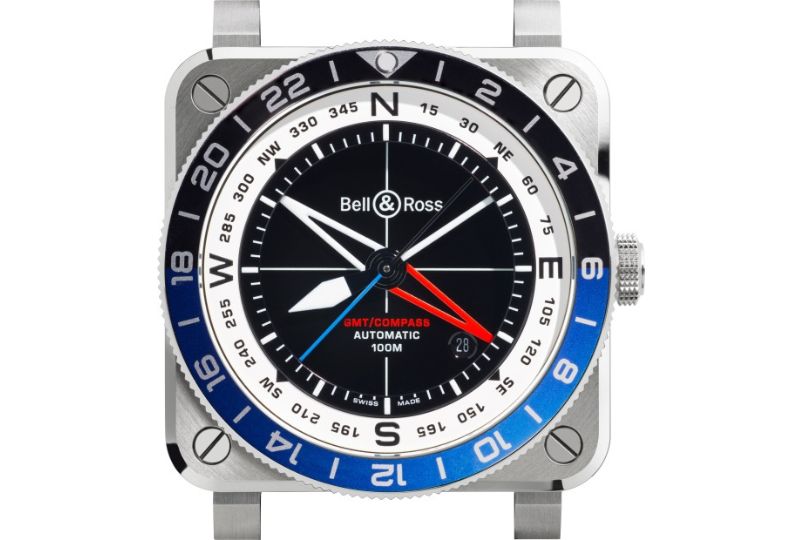
Essential to all forms of navigation – at sea, on land and in the air – the compass remains a key feature of modern dashboards. In the 21st century, it reinvents itself for the wrist in the form of a watch: the BR-03 GMT Compass from Bell & Ross, blending the familiar design of the compass with the practicality of a GMT function.

A man wearing the BR-03 GMT Compass
Designed as a true travel instrument, the new BR-03 GMT Compass follows the successful principle of the dual time zone, first introduced by the Maison in 2007 with the BR-03 51 GMT Titanium. This function is highly appreciated by globetrotters, as it allows instant reading of two time zones simultaneously.
The new model is based on the recent BR 03-93 GMT. Highly legible and easy to use, this robust, reliable timepiece is water-resistant to 100 metres and features a 24-hour graduated anodised aluminium bezel. The blue section displays daytime hours, while the black segment indicates nighttime hours. This round bezel is mounted on a 42 mm square case-a hallmark combination of round and square shapes typical of Bell & Ross design. The four screws positioned at the corners of the case are also signature details, recalling aircraft cockpit instruments. Inside beats a BR-CAL.303 automatic mechanical movement offering a 54-hour power reserve, ensuring precision and performance.
Evocative yet practical, the compass motif on the new BR-03 GMT Compass dial is not merely decorative. With its degree scale, it serves a true navigational function. On a sunny day, you can easily use your watch to find direction, thanks to the combination of the compass rose graduation and the 24-hour GMT hand indicating the second time zone.
This GMT hand is diamond-shaped – just like a traditional magnetic compass needle. The four cardinal points (North, South, East, West) are marked on the flange at 6h, 12h, 18h, and 24h. To determine direction using the sun’s position (as in an orienteering course), simply lay the watch flat and parallel to the ground. Start by setting the GMT hand to solar time.
For example, in summer in Geneva, solar time is two hours behind official time when it’s 2pm therefore officially, it’s only noon by the sun. Then, point the red hand towards the sun, and you’ll be able to read your direction on the dial’s graduated scale. Just like the explorers of the past, you can follow your course with precision, says the brand.
The history of Bell & Ross began in 1994, driven by two friends, Carlos-A Rosillo and Bruno Belamich, both passionate about watchmaking and aviation. With a Franco-Swiss heritage, Bell & Ross quickly became a reference in the field of professional aviation watches.
&uuid=(email))