

US Consumer prices increased less than expected in January amid cheaper gasoline and a moderation in rental inflation, but households faced higher costs elsewhere, suggesting little urgency for the Federal Reserve to resume cutting interest rates before summer.
The Consumer Price Index report from the Labour Department yesterday showed underlying inflation pressures warmed up last month, likely as businesses pushed through start-of-the-year price increases for goods and services, including personal care, recreation as well as airline fares and hospital services.
Still, the slowdown in overall inflation will be welcomed by President Donald Trump, whose approval ratings on the economy have taken a hit amid anxiety over jobs and affordability.
The report followed on the heels of news this week of an acceleration in job growth in January and a drop in the unemployment rate to 4.3pc from 4.4pc in December.
“Looking at the breakdown, this was a noisy report,” said James McCann, senior economist, investment strategy at Edward Jones.
“Overall, the data suggest that price pressures remain a little too hot for comfort for the time being, but the direction of travel for inflation continues to look to be lower, even if this has proved a bumpy and slow process. For the Fed, this probably doesn’t change much in the near term.”
The Consumer Price Index rose 0.2 per cent last month after an unrevised 0.3pc gain in December, the Labour Department’s Bureau of Labour Statistics said.
Economists polled by Reuters had forecast the CPI increasing 0.3pc. With January’s CPI report, the BLS published recalculated seasonal adjustment factors to reflect 2025 price movements.
The report was slightly delayed by last week’s three-day shutdown of the federal government.
A longer shutdown last year prevented the collection of prices for October, causing volatility in the CPI data.
The cost of shelter, which includes rents as well as motel and hotel stays, increased 0.2pc after surging 0.4pc in December.
Food prices rose 0.2pc after accelerating 0.7pc in the prior month.
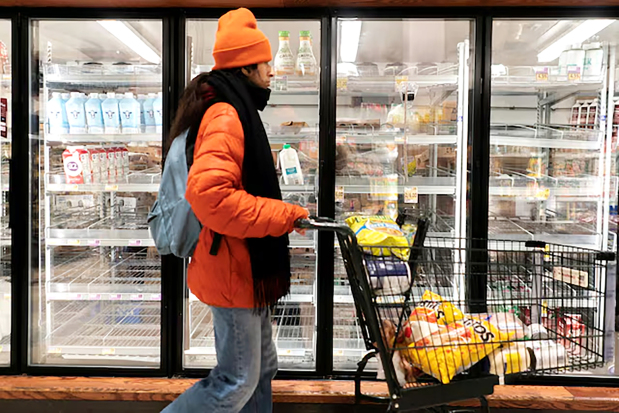
Grocery store prices climbed 0.2pc as more expensive cereal and baked goods were partially offset by a 0.4pc easing in the cost of beef and veal.
Eggs and coffee were also relatively cheaper last month as were fresh fruits and vegetables.
The Trump administration has rolled back and cut tariffs on some imported food.
Still, food prices increased 2.9pc from a year ago.
Consumers also got more relief at the pump, with gasoline prices dropping 3.2pc in January from the prior month.
Though electricity prices dipped 0.1pc, they surged 6.3pc year-on-year, reflecting demand from data centres to power artificial intelligence.
In the 12 months through January, the CPI increased 2.4pc.
The slowdown in the year-on-year inflation rate from 2.7pc in December mostly reflected last year’s higher readings dropping out of the calculation.
US stocks opened lower.
The dollar was little changed against a basket of currencies. US Treasury yields fell.
The US central bank tracks the Personal Consumption Expenditures Price Indexes for its 2pc inflation target.
Both measures are running well above target.
The government reported this week that job growth accelerated in January and the unemployment rate fell to 4.3pc from 4.4pc in December.
The Fed last month left its benchmark overnight interest rate in the 3.50pc-3.75pc range.
Excluding the volatile food and energy components, the CPI increased 0.3pc after rising by an unrevised 0.2pc in December.
Core CPI numbers have overshot expectations every January, with economists saying the seasonal adjustment factors, the model used by the BLS to strip out seasonal fluctuations from the data, were not fully accounting for the one-off turn-of-the-year price increases.
The cost of personal care jumped 1.2pc, while recreation increased 0.5pc and communication rose 0.5pc.
Airline fares soared 6.5pc. Owners’ equivalent rent increased 0.2pc.
Healthcare costs increased 0.3pc, with prices for hospital services shooting up 0.9pc and physicians’ services rising 0.3pc. But prescription medication prices were unchanged.
Apparel prices increased 0.3pc, a sign of continued pass-through from tariffs.
In the 12 months through January, the so-called core CPI increased 2.5pc after advancing 2.6pc in December.
That also reflected last year’s higher readings dropping out of the calculation.
&uuid=(email))