

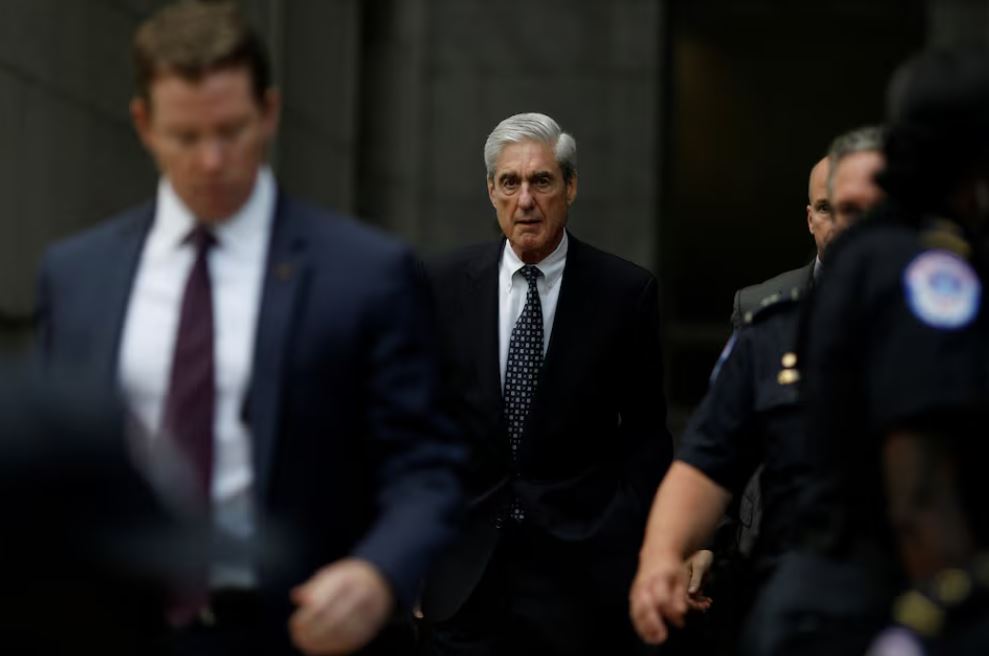
Robert Mueller, the no-nonsense former FBI chief who documented Russia’s interference in the 2016 US election and its contacts with Donald Trump’s campaign but opted not to bring criminal charges against a sitting president, has died at age 81, multiple news outlets reported yesterday.
His death was reported by MS NOW and a New York Times journalist who posted a statement attributed to the Mueller family. No cause of death was given for Mueller, a decorated Vietnam War veteran who led the FBI in the aftermath of the September 11, 2001 attacks on the US.
The New York Times last year reported that Mueller had Parkinson’s disease.
Mueller retired after 12 years as Federal Bureau of Investigation director in 2013 but was summoned back to public service by a senior Justice Department official four years later as a special counsel to take over an inquiry into Russia’s election meddling after Trump fired then-FBI chief James Comey.
Mueller conducted a 22-month investigation that produced indictments against 34 people, including several Trump associates as well as Russian intelligence officers and three Russian companies, and a series of guilty pleas and convictions. Mueller ultimately stopped short of a criminal indictment of the Republican president, bitterly disappointing many Democrats.
Trump yesterday celebrated Mueller’s passing. “Good, I’m glad he’s dead,” Trump wrote on the Truth Social site. “He can no longer hurt innocent people!”
During his career as a prosecutor and FBI chief, Mueller displayed a patrician manner and sometimes wooden personality – just about the opposite of the bombastic Trump. He was known by some as “Bobby Three Sticks” because of his full name – Robert Mueller III – a moniker that belied his formal bearing and sober approach to law enforcement.
His Russia inquiry, detailed in a 448-page 2019 report, laid bare what Mueller and US intelligence agencies have described as a Russian campaign of hacking and propaganda to sow discord in the US, denigrate 2016 Democratic presidential candidate Hillary Clinton and boost Trump, the Kremlin’s preferred candidate. Russia denied election interference.
“First, our investigation found that the Russian government interfered in our election in sweeping and systematic fashion,” Mueller said during 2019 congressional testimony.
“Second, the investigation did not establish that members of the Trump campaign conspired with the Russian government in its election interference activities. We did not address ‘collusion,’ which is not a legal term. Rather, we focused on whether the evidence was sufficient to charge any member of the campaign with taking part in a criminal conspiracy. It was not,” Mueller added.
&uuid=(email))