

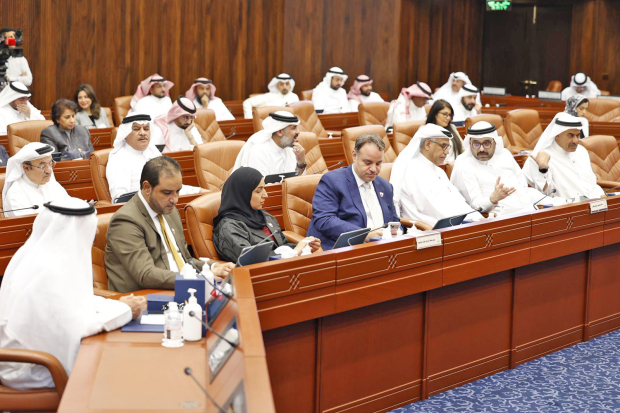
My team and I were keen to attend the parliamentary session and closely observe the application of parliamentary customs and laws in their full detail. Yesterday, we made it a point to witness firsthand the actions taken by legislators regarding the membership of Abdulnabi Salman, Mamdooh Al Saleh and Dr Mahdi Al Shuwaikh.
Although the session was procedural in nature – limited to a roll-call vote on revoking the membership of each of them, without opening the door for debate and relying solely on the report submitted by the Legislative Committee – we nevertheless believe that this was a truly historic moment.
Through this, the legislative authority in the kingdom demonstrated its ability to self-correct through constitutional and procedural mechanisms that reflect the maturity of our democratic experience.
The people of Bahrain closely followed the proceedings, reaffirming the importance of public oversight of Parliament. This reflects the nation’s faith in the democratic process and the determination of its citizens to ensure their representatives genuinely serve national interests and do not align with forces hostile to them.
The strength of institutions is not measured by the absence of mistakes, but by their ability to address them within constitutional and legal frameworks that preserve the dignity of the state and the standing of its institutions.
This incident has taught us that honourable members of Parliament, before making any random or ill-considered decisions, should consult legal advisers and seek guidance regarding what should or should not be said in such situations.
In democracies worldwide, parliamentarians rely on legal advisers to guide them on matters that may not be fully understood and to ensure their actions align with constitutional and parliamentary norms.
No MP should assume that parliamentary immunity grants the right to speak in ways inconsistent with society’s values and patriotism, as every statement made by an MP carries a message that influences public opinion and shapes the awareness of future generations.
We do not say this out of intimidation or schadenfreude towards anyone, but from our belief in the role of the Press in enlightening minds about their responsibilities, while striving to achieve a Parliament capable of effectively serving its nation.
Members of Parliament must recognise that there is no school dedicated to training parliamentarians. Many legislators become masters of parliamentary work through experience and long years of fulfilling their national duty.
To reach such a level of maturity as representatives, we must understand that knowledge and sound counsel are the proper path for disciplined legislative and oversight work, and that the honour of representing the people is not merely a matter of prestige, but a profound national responsibility – if only people understood.
Participation in the legislative authority, as one of the three branches responsible for managing the affairs of the state, is a great responsibility that requires every MP to work diligently to live up to the oath they swore to defend the nation’s interests.
As much as parliamentarians wish to criticise with absolute freedom, they must also accept constructive criticism from the Press. When the national Press monitors and criticises, it is not targeting individuals; rather, it is defending the quality of public performance and preserving public trust in institutions.
I have followed the return of parliamentary life since the launch of the reform project in 2002, and the Press has always given great attention to the electoral process, dedicating extensive coverage to the activities of Parliament.
It has also witnessed the council’s transformations, stumbles and developments, stemming from my belief that this council is the product of a democratic process established in this country through a noble royal will aimed at enhancing participatory governance. We must preserve the continuity of these achievements so that future generations can trust Parliament’s ability to meet their aspirations for the future.
I emphasise once again that these words are not an attempt to impose guardianship over Parliament, nor are they an expression of satisfaction over the revocation of anyone’s membership. Rather, they are intended to share together the responsibility of preserving our national values and contributing to an intellectual reassessment of certain practices undertaken by some without awareness of the dangers they pose to the minds of children and youth.
In the history of nations, there are defining moments that help correct the course of national action. Perhaps the Iranian aggression and its repercussions represent such a pivotal moment, exposing certain misconceptions held by some segments of society.
It is also an opportunity for those aspiring to run in future parliamentary elections to realise the importance of preparing themselves for this great responsibility through education, self-development, and assembling a team of knowledgeable experts – not merely cheerleaders who applaud everything an MP says without correcting their course.
An MP is not merely a legislator, but also a shaper of public consciousness.
It is also a message to voters: do not be swayed by sweet or polished words, nor become the reason an unsuitable candidate reaches Parliament.
True democracy does not excuse mistakes; it demands the courage to correct them to safeguard the nation and uphold the dignity of its institutions.
&uuid=(email))