

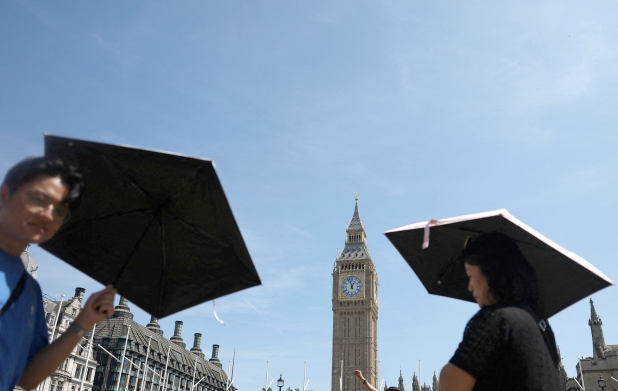
England and Wales experienced their driest July on record, the Met Office said yesterdat, citing provisional data.
The UK received just 35 per cent of its average July rainfall, making it the driest July nationwide since 1868, while southern England recorded its driest month since records began in 1836.
The prolonged heat and lack of rainfall are part of a wider European climate crisis, with devastating wildfires continuing in Greece, and Romania taking the unprecedented step of blasting a rock outcrop in the Danube to redirect cooling water to its only operational nuclear reactor.
Record low water levels in major rivers have disrupted the transport of goods, including grains and oil, while reducing hydropower generation in several European countries.
The UK – which comprises England, Scotland, Wales and Northern Ireland – received just 35pc of average July rainfall, making it the driest July nationally since 1868.
An estimated 2,877 people in Britain have died from heat-related causes so far this year.
Record low water levels in Europe’s major rivers have curtailed the transport of goods, reduced electricity output and shrunk company earnings, stoking fears about the economic impact of searing heat and erratic rainfall.
As Europe experiences the fastest warming of any continent and record-breaking heatwaves, drought has exposed the need to reconsider business practices.
Hundreds of Greek firemen battled a wildfire northwest of Athens for a fourth day yesterday after strong and erratic winds helped it devastate homes, pine forests and thousands of hectares of farmland, forcing emergency evacuations by land and sea.
Romania blew up a rock outcrop yesterday to help redirect vital cooling water from the drought-hit Danube river to its soleworking nuclear reactor,an unprecedented measure underlining the scale of an energy crunch across the region.
In neighbouring Hungary, authorities said they might be able to eke out two more days of power from their only atomic plant, which has been hit by falling levels in the Danube that it also relies on as a coolant.
A record heatwave is gripping the Korean peninsula, sending temperatures soaring across South Korea and North Korea as authorities expand emergency measures and residents seek relief in cooling shelters, beaches and water parks.
Forecasters said on Monday that extreme heat was spreading into the Seoul metropolitan area and other western regions.
&uuid=(email))