

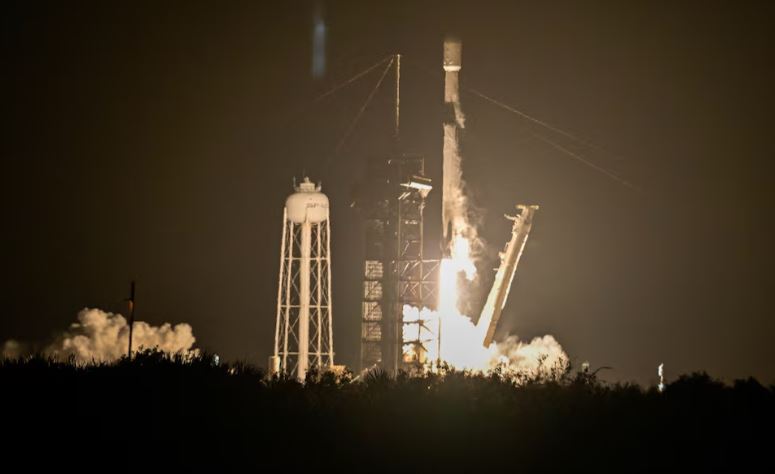
A SpaceX rocket piece floating in space since last year smashed into the moon at high speed early yesterday, joining the ranks of meteoroids, wayward spacecraft and other pieces of space junk that have bombarded the lunar surface for ages, astronomers confirmed.
The school-bus-size object is the second stage of a SpaceX Falcon 9 rocket that had launched a lunar lander from Firefly Aerospace toward the moon in January 2025.
Its predicted collision with the moon became a spectacle for astronomers and space enthusiasts eager to watch how it would unfold.
Weighing 4,000kg, the rocket body slammed into the moon around 2.35am ET (0635 GMT), travelling at 8,690kmph.
None of the few spacecraft orbiting the moon were positioned to capture close-up images of the impact.
But at the Paranal Observatory in Chile, the European Southern Observatory’s Very Large Telescope detected glimmers of light associated with the impact.
“We can confirm that the telescope detected spectral lines of sodium and lithium gas in the impact plume lasting for 5-10 minutes after impact,” an ESO spokesperson told Reuters.
The impact occurred near the moon’s terminator line, or the boundary of its shadow between the sunlit side and its far side.
Similar to past objects that have hit the moon, the rocket stage kicked up a plume of lunar dust that was briefly illuminated by sunlight, but difficult to spot with the naked eye from Earth.
How the impact plume interacted with the sunlight allowed astronomers to glean clues about its composition.
The sodium gas evidenced in the spectra is believed to have originated from the lunar soil, while the traces of lithium may have come from the rocket stage itself, Carl Schmidt, the lead astronomer conducting the impact observations, told Reuters.
The impact was unintentional, SpaceX said. The rocket piece was expected to hit near Einstein Crater on the moon’s western limb, which is often difficult to see from Earth.
Such stages typically fall back into Earth’s atmosphere and burn up or plunge into the ocean after boosting the rocket’s payload to a precise spot in orbit.
But because the January lunar lander mission required more thrust than missions closer to Earth, the rocket’s second stage remained in space, floating aimlessly among thousands of other pieces of space junk that active satellites must steer clear of.
&uuid=(email))