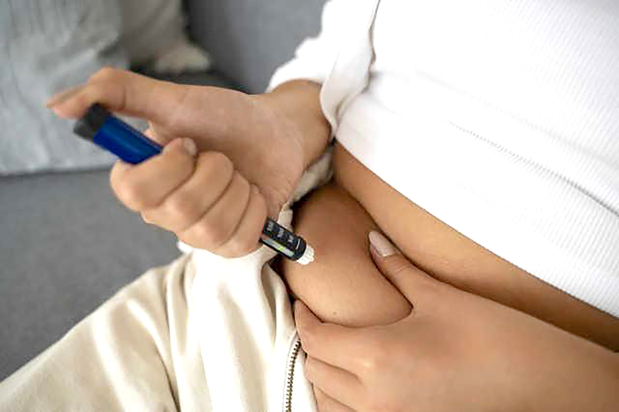
Health professionals in Bahrain are urging people with diabetes to rotate their insulin injection sites rather than repeatedly using their ‘favourite spot’, warning that poor habits can affect blood sugar control and damage the skin.
Using the same spot over and over can cause fatty tissue buildup, resulting in lumps and hardened areas that may interfere with insulin absorption.
This can lead to unpredictable blood sugar levels, including unexpected highs and lows, as well as increased insulin requirements and, over time, scar tissue.
Awali Hospital consultant endocrinologist Prof Dalal Alromaihi told the GDN she frequently sees patients who have been injecting into the same area for months or even years.
“Patients naturally develop a favourite spot because it is convenient and less painful,” she said.
“Because of this, I see patients come to the clinic with unexplained high glucose readings, significant glucose variability, or unexpectedly frequent hypoglycaemia.
“Upon examination, I find they have been repeatedly injecting insulin into the same small area where lumps have developed.
“This is why, when I see unexplained fluctuations in glucose levels, I do not immediately assume that the patient needs more insulin. Instead, I ask them to show me exactly where and how they inject,” she added.
Prof Alromaihi said correcting the injection technique and moving to healthy areas of skin can significantly improve glucose control.
The recommended injection sites include the abdomen, thighs, upper outer arms and buttocks. Insulin should be injected into the fatty layer beneath the skin rather than into muscle.
“The abdomen is generally a very reliable and convenient site and tends to provide relatively consistent absorption,” she said, adding that traditionally, absorption from the thighs and buttocks may be somewhat slower.

Prof Alromaihi
Prof Alromaihi also explained that the way insulin is administered is important.
“It should be given into healthy subcutaneous fatty tissue,” she stated. “With the short pen needles commonly used today, particularly a 4-6mm needle, the needle can generally be inserted straight into the skin at a 90-degree angle.
“After pressing the injection button completely, I advise patients to keep the needle under the skin for approximately 10 seconds before withdrawing it. This helps ensure that the full dose has been delivered.”
For patients who find it difficult to remember to rotate their injection sites, pharmacist and Bahrain Diabetes Society member Amal Jasim recommends using a simple visual method.
She suggested imagining the abdomen as the face of a clock, with the navel at the centre.
“Think of 12 o’clock as the upper abdomen, 3 o’clock as the right side, 6 o’clock as the lower abdomen and 9 o’clock as the left side,” she said.
“The clock is not a prescription for exact injection points; it is simply a memory tool to help prevent repeatedly using the same spot.
“Patients should also avoid the area around the navel, as well as any bruised, scarred, inflamed, hardened or visibly lumpy skin.”

Ms Jasim
Ms Jasim also stressed the importance of using a new needle for every injection, saying that reusing needles can contribute to tissue trauma and is associated with a higher risk of lipohypertrophy, or the development of thickened lumps in the fatty tissue.
“A small bruise or a drop of blood can occasionally occur if a tiny blood vessel is touched. However, increasing redness, warmth, swelling, significant pain or discharge should be medically assessed,” she said.
She also urged patients to make checking their skin part of their routine before every injection.
“Another important habit is to look at the skin before injecting for a quick check for lumps, firmness, bruising or any changes, to prevent repeated injections into unhealthy tissue.
“An insulin injection may take only a few seconds, but those seconds are part of effective diabetes care.
“So before the next injection, remember three words – rotate, inspect and avoid.”
Diabetes affects more than 15 per cent of adults in Bahrain, with lifestyle factors like diet and lack of exercise driving a rise in type 2 cases.
julia@gdnmedia.bh