

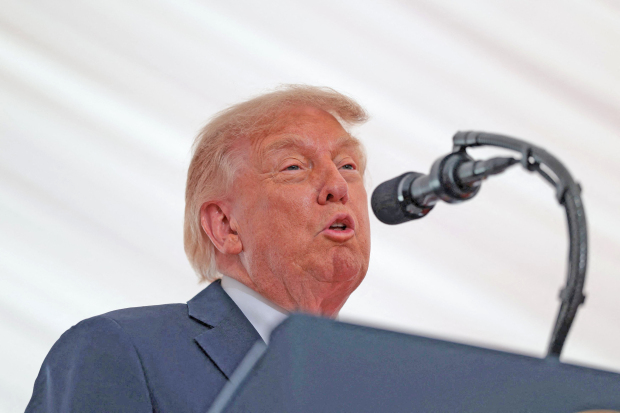
US President Donald Trump said yesterday he would ‘love’ to see British-run Northern Ireland unify with Ireland, remarks made during a visit to Dublin that drew a sharp response from pro-British unionists in Northern Ireland.
Trump’s comments come weeks after new British Prime Minister Andy Burnham said a referendum on Northern Ireland leaving the United Kingdom was ‘off the table’, a position Downing Street yesterday said remained unchanged.
Trump later said that there ‘was no good answer’ to the question on Irish unity but repeated that he thought it would be ‘a very cool thing’.
Under the terms of the 1998 Good Friday Agreement, a referendum can be held only at the discretion of the British government. The accord ended three decades of violence between Irish nationalists seeking a united Ireland and unionists who wanted Northern Ireland to remain part of the UK.
While polls show a comfortable majority in Northern Ireland favour remaining in the UK, the gap has narrowed slightly since Britain’s departure from the European Union pushed unity higher up the political agenda.
The leader of the Democratic Unionist Party, Northern Ireland’s largest party advocating continued union with Britain, rejected Trump’s prediction, saying unification with Ireland would lead to ‘the destruction of our country’.
“Northern Ireland’s constitutional future will be decided by the people of Northern Ireland, not by commentary in London, Dublin or Washington,” Gavin Robinson, who has publicly supported Trump in the past, wrote on X.
In Belfast, supporters of Irish unity gave a guarded response.
“I think it’s just headline grabbing ... I don’t think he gives a toss whether there is a United Ireland or not,” said Eamon Hanna, a supporter of the nationalist SDLP party, which has been a strong critic of Trump’s policies.
Previous US presidents, including those with strong Irish heritage like Joe Biden, have been careful to remain neutral on Irish unification. The US government played a key role in brokering the 1998 peace deal.
Trump also met Irish President Catherine Connolly, who had joined a protest against his 2019 visit to Ireland, before she was elected to the mostly ceremonial role last year.
&uuid=(email))