


People who use artificial intelligence (AI) to create deepfake images, audio or video portraying another person could face up to five years in prison and a BD50,000 fine under a proposed law put forward by five MPs.
The bill, spearheaded by Dr Hisham Al Asheeri and co-signed by Mohsin Al Asbool, Jalila Al Sayed, Hanan Fardan and Bassema Mubarak, seeks to add a new offence to Bahrain’s Information Technology Crimes Law to tackle the misuse of AI-generated content.
Under the proposal, deliberately using AI without a legal justification to create, generate, alter or combine images, audio recording or video attributed to another person in a way that could make it appear genuine – and which infringes that person’s privacy – would be punishable by imprisonment and a fine of up to BD30,000, or either penalty.
The punishment would rise sharply where the material is published, made available, sent or circulated, or where the offence is committed with the intention of blackmailing, threatening, defaming or harming the victim.
In such cases, the proposed maximum punishment would be five years’ imprisonment and a BD50,000 fine, or either penalty.
Dr Al Asheeri said the rapid development of AI had created powerful tools capable of producing material that can closely resemble reality, making it increasingly important for the law to keep pace with the technology.
“Artificial intelligence offers enormous opportunities across legitimate fields, but its misuse can cross the line into an invasion of privacy, cause damage to reputation and personal dignity, and even lead to blackmail and threats,” he said.
He stressed that the proposed amendment was aimed at closing a potential legal gap surrounding fabricated material that is made to appear as though it genuinely originated from an individual.
“When technology is used to make the public believe that fabricated images, recordings or videos are genuine and were produced by another person, the consequences can be deeply damaging. The law must provide effective protection against such abuse,” Dr Al Asheeri said.
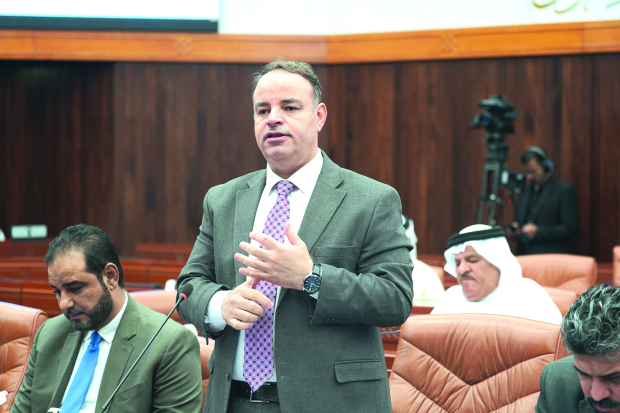
Dr Al Asheeri
Deepfake refers to the use of AI and machine learning to create convincing, synthetic media – images, audio or video – that depict people saying or doing things they did not actually say or do.
The co-sponsors said the proposal reflects the need to respond to the changing nature of digital offences as AI tools become more accessible and sophisticated.
Mr Al Asbool said stronger legal safeguards were needed to protect individuals from technology being used against them, particularly where fabricated content is circulated beyond its original target.
Ms Al Sayed highlighted the importance of protecting privacy and personal dignity in the digital environment, while Ms Fardan stressed the need to ensure that technological progress is accompanied by appropriate legal safeguards.
Ms Mubarak said the proposed legislation would help address harmful uses of AI while preserving its legitimate applications, including innovation, creativity and other beneficial uses.
The bill would also introduce a legal definition of ‘AI technologies’.
The MPs said AI itself was not the target of the proposed legislation. Instead, the measure focuses on deliberate and unlawful misuse, particularly where fabricated content is designed to deceive others or cause harm.
The GDN previously reported that a warning was issued urging people not to fall for an online scam after a ‘deep-fake’ video was posted on social media portraying a Bahrain minister supposedly promoting a get-rich-quick investment scheme.
The General Directorate of Anti-Corruption, Economic and Electronic Security said the post was created using artificial intelligence in a bid to promote a fraudulent business opportunity.
For complaints contact the directorate’s hotline on 992.
mohammed@gdnmedia.bh
&uuid=(email))