

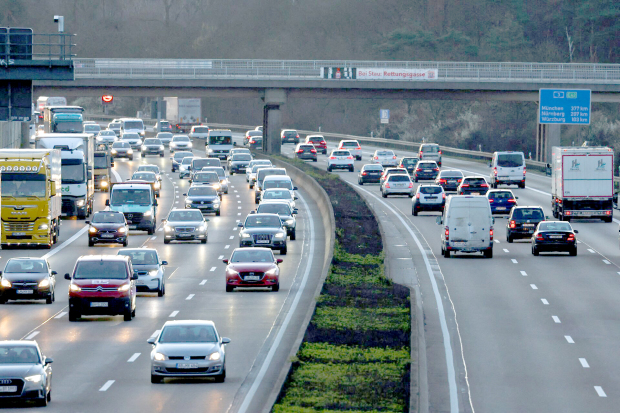
France and Germany struck a deal yesterday to soften proposed EU car emissions rules and open the door for Britain to be treated as a trusted partner under the bloc’s ‘Made in EU’ rules.
The European Commission proposed last year that automakers cut CO2 emissions by 90 per cent from 2021 levels in 2035, with the remaining 10pc offset through measures such as the use of low-carbon steel and alternative fuels.
Under the Franco-German plan, the 2035 target would be set at 90pc, but without the need for additional compensatory measures. The approach is broadly in line with the wishes of German automakers.
European automotive stocks gained after the deal was announced, lifting the STOXX 600 Automobile and Parts Index nearly 2pc.
The joint plan also addresses an EU proposal introducing local-content and low-carbon requirements for products bought through public procurement, public auctions or subsidy schemes.
France has pushed for these products to be limited to those manufactured in the European Union. Other EU members, including Germany, argue that countries closely linked to EU automotive supply chains and free-trade-agreement partners should also be included.
The Franco-German plan says that for the automotive sector, “Made in EU” should cover the EU’s 27 countries and other European partners that were part of the EU internal market on January 1, 2020.
That would include Britain, which left the EU single market at the end of 2020.
An official at British Prime Minister Andy Burnham’s Downing Street office said inclusion in the ‘Made in EU’ scheme would be good news for Britain’s automotive sector. However, he said the Franco-German proposal would need wider European backing and that details had yet to be seen.
The Franco-German plan also says that inclusion should be subject to an agreement on full reciprocity, along with ‘dynamic alignment with EU conditions for investment from third countries and with EU trade protection measures’.
That could mean Britain adopting measures the EU has taken to restrict imports of Chinese-built hybrid and battery-electric vehicles.
The Franco-German paper also proposed compliance periods spanning multiple years for CO2 emission targets, no revision before 2030 of the utility factor for hybrid vehicles, which measures the share of driving done electrically, and recognition of cars powered by renewable and low-carbon fuels as zero-emission vehicles.
&uuid=(email))