

Bahrain will never forget the ‘heinous and unjustifiable attacks’ by Iran that targeted key infrastructure and killed and injured civilians, said a top minister last night.
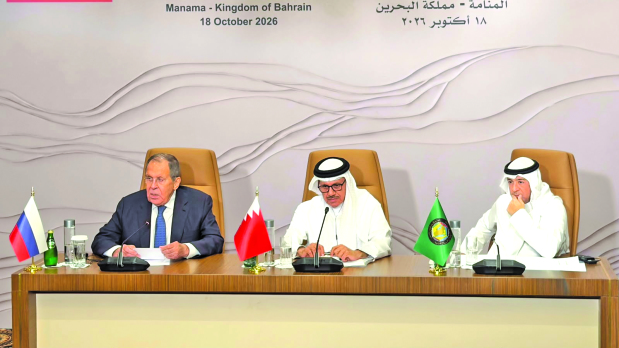
Foreign Minister Dr Abdullatif Al Zayani was speaking during a Press conference at The Ritz-Carlton, Bahrain alongside his Russian counterpart Sergey Lavrov, and the Gulf Co-operation Council (GCC) secretary-general Jasem Al Budaiwi.
Dr Al Zayani, while replying to a question on Bahrain’s firm stance of not participating in a proposed Oman-backed ministerial meeting last month with Iran on the situation in the Strait of Hormuz (later postponed), stressed that in order to attend such a meeting, diplomatic relations between the two countries need to be first restored.
“We had an invitation to hold a collective meeting with Iran and other GCC state members to talk about the Strait of Hormuz situation, but Bahrain’s position is clear that freedom of navigation is a key principle in our foreign ministry policies.
“We have seen the negative economic impact globally, whether it’ s fertilisers shipments or in the energy sector, the Strait should return to its normal operations before February 28 with no tariffs imposed, or any sort of individual management for this critical passage, in line with international laws.”
Dr Al Zayani said the next step requires resumption of diplomatic ties with Iran, while highlighting clearly that Tehran’s attacks in Bahrain cannot be neglected.
“They were heinous and unjustifiable attacks that targeted economic infrastructures and civilians with so many casualties.
“We all know, especially Bahrainis, we don’t forget our daughter Sara Dashti, who was eating her food during Ramadan before fasting … she was killed.
“These things we can’t forget about, or neglect them, and then move to a meeting.”
The GDN reported in March that the 29-year-old Bahraini was killed when an Iranian attack targeted a building in the Seef District.
She was believed to have been enjoying refreshments at a coffee shop below an office tower when the strike happened and was killed by falling debris.
The attack also injured eight others.
Dr Al Zayani said it’s imperative to have the foundations for a relationship established, with the most important thing right now being to stop all attacks permanently.
“We need to have mutual respect, respect sovereignty, and non-interference in the internal affairs of other countries.
“We cannot achieve security by just neglecting these attacks, or trying to forget what we went through.
“If the foundations are adopted and understandings are clear, then yes, dialogue will be the only thing.”
Mr Lavrov, who attended the 9th GCC- Russian joint ministerial meeting for strategic dialogue yesterday, agreed with Dr Al Zayani and called for freedom of navigation conditions to remain like before February 28.
“As mentioned by the minister about mutual respect for sovereignty and non-interference of military against each other, I thought maybe all of this has been applied to what Israel and the United States did … I was mistaken,” said the Russian diplomat.
The visiting minister backed his statement by citing statements made by US President Donald Trump on how ‘we got rid of the Iranian leaders’, he said.
“This kind of American approach is not assisting in getting the region out of the crisis based on mutual respect and international law,” he added.
Mr Lavrov said it is important to not look at the crisis from one side or perspective, as it could lead to manipulation.
“Some parties are trying to make the international community focus on one part of this full picture of the crisis,” he claimed, while assuring his country welcomes all regional and global mediators to end this conflict.
“We are calling for respect of the international treaties agreed upon, but unfortunately, some parties in the West don’t have this approach.”
The ongoing attacks by the Iranian-backed Houthis in Yemen targeting Saudi airports and oil facilities were also discussed during the high level meeting hosted in Bahrain.
The conflict is a new theatre in the wider regional war that began with US and Israeli strikes on Iran in February.
Mr Al Budaiwi earlier in the day during the meeting with his GCC foreign ministers and the visiting Russian delegation highlighted that since February 28, the GCC member states faced grave challenges from the Iranian attacks involving more than 7,000 ballistic missiles and unmanned aerial vehicles (UAVs).
These attacks, he said struck airports, ports, power stations, water desalination plants, and oil and gas facilities, claiming the lives of innocent civilians in a war in which the GCC states were not a party.
“These aggressions were not limited to direct Iranian strikes, but extended to include attacks by the terrorist Houthi militia, which escalated its assaults on Saudi Arabia by targeting airports, civilian objects and energy facilities,” he said.
“Foremost among these was the brutal attack on King Khalid International Airport in Riyadh on October 10, which claimed the lives of 12 people – both citizens and residents of various nationalities – and injured more than 300 others, in flagrant violation of international law and international humanitarian law,” said Mr Al Budaiwi.
Dr Al Zayani said that Bahrain stands side by side with neighbouring Saudi Arabia following the series of Houthi attacks and welcomed a UN declaration that condemned these aggressions and Saudi’s right to self defence according to international law.
The Russian Foreign Minister on the issue called for political and diplomatic solutions to end the crisis.
On the Palestinian issue, Dr Al Zayani said: “We discussed the Palestinian cause and ceasefire efforts to facilitate humanitarian aid, and these efforts must be exerted to achieve sustainable and comprehensive peace with the right of the Palestinian people for their independent state based on the 1967 borders with East Jerusalem as its capital.”
However, Mr Lavrov, in remarks last night, said they agreed to adopting the UN resolution initiated by President Trump to end the crisis in Gaza.
The 20-point Comprehensive Plan to End the Gaza Conflict was adopted last year authorising an international stabilisation force for the Palestinian enclave.
Russia, which holds a veto on the Security Council, signaled potential opposition to the resolution but abstained from the vote, allowing the resolution to pass.
“We did not object to it, and now after a year with all the situations and conditions at the time, there have not been any implementations, but we are going to work to achieve the Palestinian legislative rights,” said Mr Lavrov.
A series of Bahraini events are expected to be organised and held in Russia next year as part of growing cultural ties between the two sides.
Mr Lavrov said Bahrain hosted a series of Russian events at the beginning of the year, and they were looking now to host Bahrain for similar cultural gatherings in Moscow.
Other topics discussed between the two sides focused on food security, transportation, education and tourism.
GCC-Russia trade totaled around $19 billion, with more room for growth with GCC countries working on the implementation of a joint action plan from 2023-2028.
