

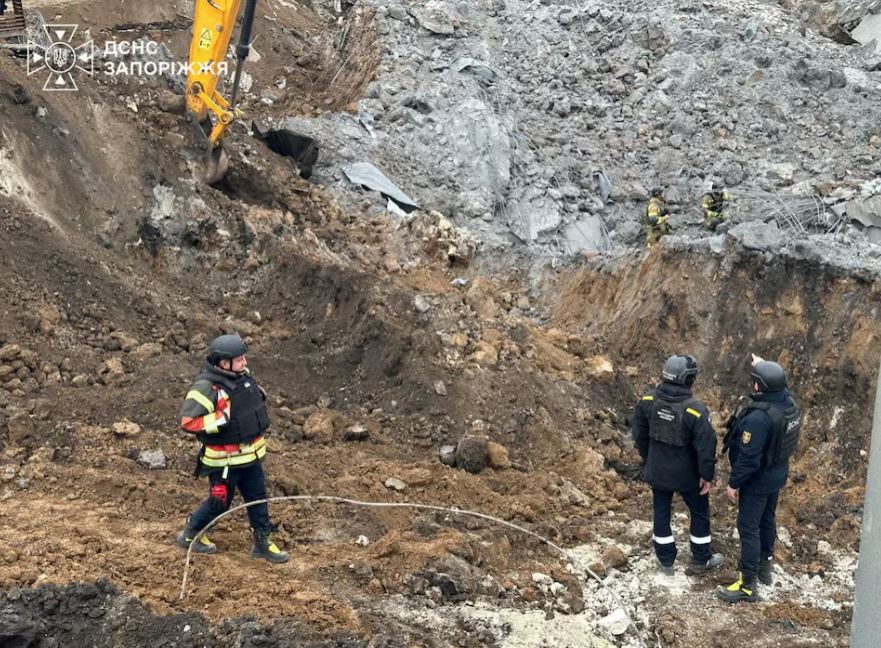
The death toll from a Russian bombing of an aid distribution point in Ukraine’s southeastern Zaporizhzhia region on Monday has risen to 40, with dozens still missing, officials said, in one of the deadliest strikes on civilians this year.
The attack came a day after a brief US-brokered local ceasefire expired and less than a week before the United States is due to bring together Ukrainian and Russian delegations in Abu Dhabi for talks on ending the war, now in its fifth year.
Reuters footage yesterday showed men in military fatigues loading bodies in white plastic bags into the back of a van in the village of Komyshuvakha, which was struck multiple times.
Excavators were digging up earth near a huge blast crater while rescue workers searched underground for bodies.
Ivan Fedorov, the co-head of the Zaporizhzhia Regional Defence Council, wrote on Telegram that 59 people were missing.
Ukrainian President Volodymyr Zelenskiy has said Russian forces first dropped aerial bombs on an underground school building being used as a distribution point as people arrived to collect aid, then struck the shelter with more bombs.
Classes have long since been suspended at the school because of its proximity to the front – Komyshuvakha lies some 17km from the nearest Russian positions – but it served as a shelter and handed out humanitarian aid every Monday, Zelenskiy said.
The World Central Kitchen (WCK) charity, which delivers food and water to the community, said the facility that was hit was a humanitarian and administrative centre for locals.
This strike hit a aid centre, said Yuliya Stefanyuk, WCK response director for Ukraine.
Two members of a rescue crew and four police officers were among the dead, emergency services said.
Russia’s defence ministry said the attack targeted Ukrainian military units around Komyshuvakha and two other settlements, and that up to 25 Ukrainian servicemen were killed.
Russia and Ukraine both deny deliberately targeting civilians.
Ukrainian anti-corruption investigators accused senior security officials yesterday of shielding a network of illegal businesses, ranging from scam centres to drugs, part of an expanding probe that could stoke tensions between key law enforcement agencies.
Top employees of Ukraine’s SBU security service, the National Police and the Prosecutor General’s Office have taken bribes to protect the criminal ring, even helping to plan attacks and kidnappings, the National Anti-Corruption Bureau said.
