

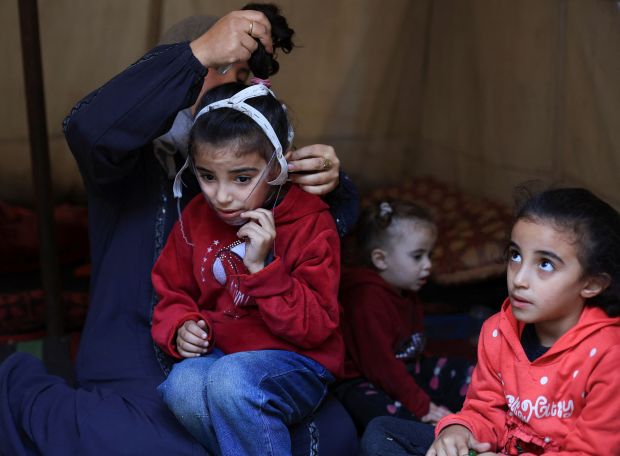
The excruciating burns run around the side of Masa Yassin’s tiny face, behind her ear, over her scalp and down her neck.
Since her family’s tent burst into flames when a nearby cooking gas tank exploded in July, part of the six-year-old girl’s treatment has been a clear plastic 3D-printed mask, which helps manage swelling and control the scars on her face.
But soon she will outgrow it, and the international medical charity Medecins Sans Frontieres, which operates the only clinic in Gaza that can make her a new one, says it has been barred by Israel from importing the plastic.
“Should there be no masks, my daughter will grow more scar tissue,” said Masa’s mother Islam Yassin, as she gently adjusted straps on the mask of the girl on her lap on a plastic chair in their tent in a camp in Gaza City.
“We would have to resort to surgery instead of masks, and there are no such surgeries in Gaza.”
More than a year since a ceasefire halted major fighting in Gaza, the entire population of more than two million Palestinians lives confined to around a third of the tiny enclave’s territory, mainly in makeshift tents and damaged buildings.
Israeli forces still control everything that enters and exits.
“A child’s mutilated face can no longer receive even a basic treatment, not because the technology or the expertise is lacking, but because Israel imposes a regime under which healing itself is a privilege,” Filipe Ribeiro, MSF’s head of mission for Palestine, said in a message to Reuters.
Demand has been surging. There are 70 patients, including 50 children, receiving treatment for facial burns, 20 of whom need masks urgently, he said.
